Poll vs. survey: Definitions, key differences, and when to use each method
Learn the key differences between polls and surveys, with clear definitions, examples, and guidance on when to use each method.

Summary:
- Polls are ultra-brief, single-question tools designed for instant "pulse checks." Surveys are multi-dimensional research methods used to uncover complex motivations and long-term trends.
- Polls deliver quick snapshots through closed-ended questions (yes/no), whereas surveys utilize skip logic and open-ended responses to transform raw data into a strategic roadmap.
- Use polls for low-friction, real-time feedback and simple decision-making. Choose surveys for comprehensive market research, customer satisfaction, and detailed behavioral analysis.
Poll or survey? With over 24 million questions answered on our platform daily, we can confidently say that we know a lot about polls and surveys.
So what’s the difference between polls and surveys? Our research scientists break down the definitions, key differences, and examples so you can choose the right tool for your audience.
Key differences between polls and surveys
The terms ‘poll’ and ‘survey’ are often used interchangeably in some contexts; however, while they are similar, there’s nuance to each, according to Senior SurveyMonkey Research Scientist Zoe Padgett.
A poll is a survey, but not all surveys are polls.
“A poll is like a very quick, short survey on a single topic that gauges opinions, likes, or votes. Whereas a survey might dive deeper into opinion and attitudes,” according to Padgett.
Use this chart as a quick poll vs. survey reference.
| Poll | Survey | |
| Definition | A poll is a single-question tool designed to quickly capture a snapshot of public opinion or preference on a specific topic. | A survey is a comprehensive research tool used to collect and analyze in-depth data from multiple questions to uncover detailed trends, motivations, and behaviors. |
| Goal | The goal of a poll is to gather immediate respondent opinion or pulse-check a specific topic. | The goal of a survey is to uncover trends, motivations, and behaviors. |
| Questions | Poll questions include yes/no and comparison formats to capture quick opinions. | Survey questions include multiple choice, rating scales, open-ended, ranking, demographic, behavioral formats to collect detailed insights. |
| Data analysis | Data analysis for polls is typically a percentage or raw count. | Survey data analysis transforms raw qualitative and quantitative data into insights you can act on. |
| Example | A teacher uses a classroom poll at the end of class to tally how many students finished reading a textbook chapter. | A professor conducts an end-of-semester student survey to understand what teaching modalities worked best and why. |
What is a poll?
Definition of a holl
A poll is a fast, single-question tool used to gauge immediate public opinion or pulse-check a specific topic in a snapshot of time.
Characteristics of polls
- Ultra-brief: Usually consists of only one question, though occasionally two or three.
- Narrow focus: Designed to measure the "pulse" on a single, specific topic rather than collecting broad data.
- Low friction: Because they take seconds to complete, they typically have much higher engagement rates than longer forms.
- Multiple choice: Almost exclusively uses closed-ended questions to make the data easy to quantify instantly.
- Simplified analysis: The data is usually represented as a simple percentage or a raw count.
When polls are most effective
People often use the terms poll and survey interchangeably. Both allow you to gather feedback from an audience. That said, polls have specific use cases that differentiate them from surveys.
- Gauging immediate sentiment: Perfect for "pulse checks" during a live event, webinar, or after a major news announcement to see how your audience feels immediately.
- Breaking the ice: Great for the beginning of a presentation or a meeting to get people interacting without asking for a significant time commitment.
- Simple decision-making: When you need a quick "show of hands" to make a minor choice, such as "Which lunch option do you prefer?”
Polls are excellent for capturing immediate, high-level sentiment. For instance, a presenter might use a poll to gauge real-time audience engagement and adjust their delivery on the fly.
Related reading: Online poll maker (tips + templates!)
What is a survey?
Definition of a survey
A survey is a comprehensive research method used to collect, aggregate, and analyze in-depth data from a specific group to uncover detailed trends, motivations, and behaviors.
Characteristics of surveys
- Multi-dimensional: Surveys typically contain a range of question types, including multiple-choice, rating scales, and open-ended text boxes.
- Logical complexity: They often use skip logic or branching to create a personalized path for the respondent.
- In-depth Analysis: Because they collect more data points, surveys allow for cross-tabulation—comparing how different groups (like age or location) answered the same question.
- Targeted sampling: Surveys are often sent to specific, segmented audiences to ensure the data is statistically significant for a particular demographic.
- Quantitative and qualitative data: They capture both hard facts (demographics) and soft feelings (sentiments, motivations, and pain points).
When surveys are most effective
Surveys also have their own unique use cases that differentiate them from polls. Because surveys cover the entire research lifecycle, they are the gold standard for:
- Market research: Testing new concepts and refining product features
- Customer sentiment: Gauging satisfaction and gathering direct feedback
- Internal health: Monitoring employee engagement and overall job satisfaction
Related reading: Survey data collection—methods, examples, & best practices
Practical examples of polls vs. surveys
Poll examples
When you need a quick pulse check, nothing beats a poll. They are designed for speed: one topic, one click, and instant results. It’s the most efficient way to turn audience opinion into immediate action. These scenarios are just a few examples of how you can use a poll.
Political poll example
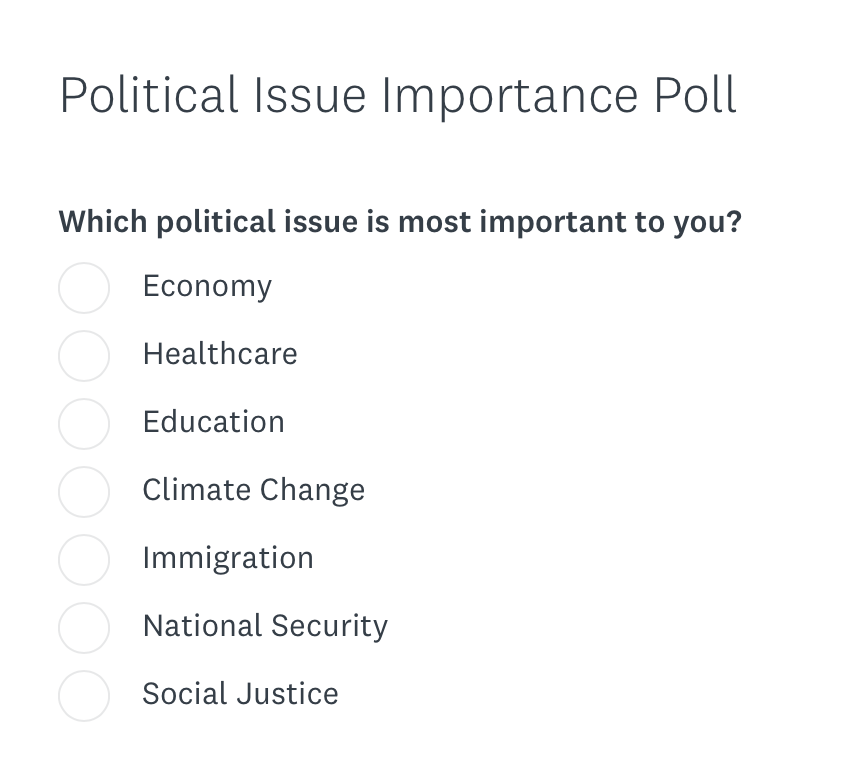
When the political climate shifts, governments and civic groups don't have months to wait for answers. They need a pulse check, and they need it now.
Enter the political opinion poll: a lean survey tool designed to strip away the noise and deliver focused voter intent and urgent priorities.
While deep-dive surveys are great for exploring the 'why' over several years, these polls provide the 'what' in real-time, capturing the raw momentum of an election as it happens.
Exit poll example
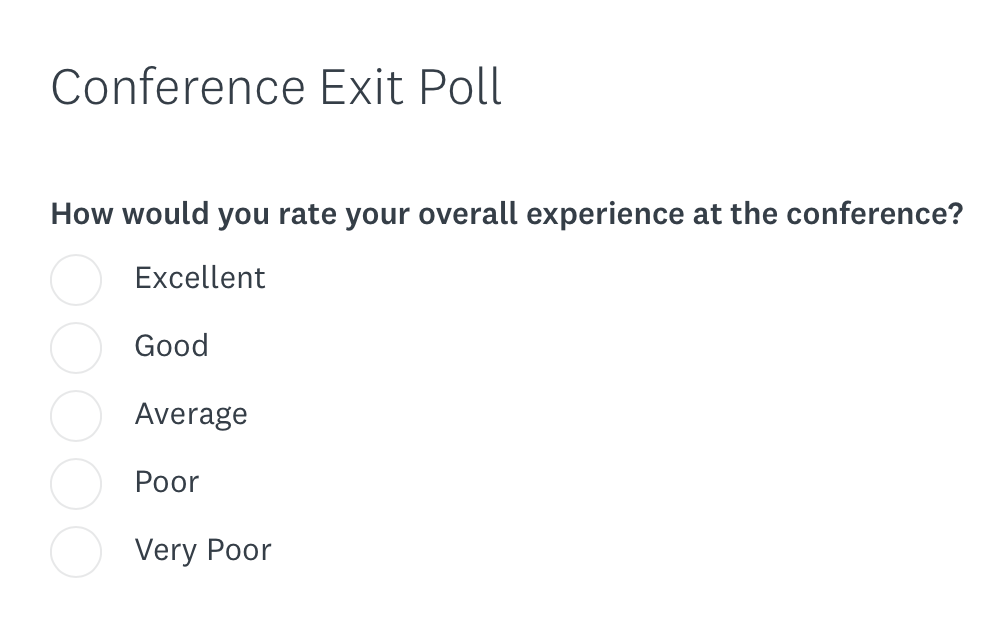
Exit polls catch people at the moment of decision.
Conducted the second a voter steps away from the ballot box or a guest leaves a conference, these polls capture raw, unfiltered reactions before they fade.
It’s the ultimate way for pollsters to pinpoint the exact issues that moved the needle, turning a single day of action into a treasure trove of insight.
Attendance poll example
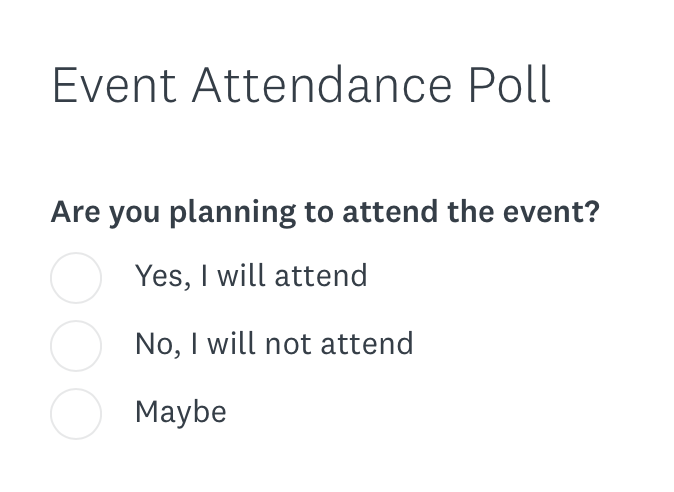
Ever ordered 50 pizzas for a group of 20?
Attendance polls are here to save your budget (and your fridge space). Think of them as a digital 'show of hands'—the fastest way for event coordinators to get a precise headcount and ensure the catering is as spot-on as the guest list.
Survey examples
When you need to move beyond the surface, nothing beats a well-crafted survey. Surveys are built for clarity: targeted questions, nuanced feedback, and comprehensive data. It’s the most effective way to transform quiet observations into a clear roadmap for your next big move. These scenarios represent just a fraction of how a survey can sharpen your strategy.

Is your customer satisfaction program actually moving the needle? NPS surveys take the mystery out of customer loyalty.
When you implement long-term Net Promoter Score tracking, you gain a high-definition view of your brand’s health, allowing you to plug retention leaks and unlock the kind of organic growth that drives real revenue.
Market research survey example
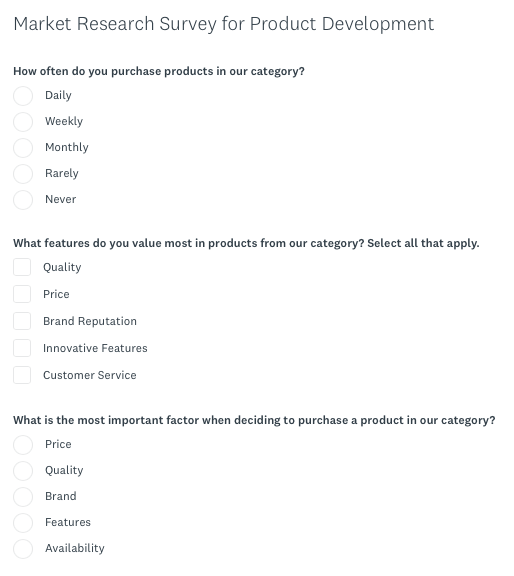
Ever wish you could read your customers’ minds—or your competitors’ playbooks?
Market research surveys are deployed to conduct competitor intelligence research to understand how a target audience responds to competitors, throughout the product lifecycle to direct development, and more.
These insights keep you two steps ahead of the crowd.
Employee satisfaction survey example
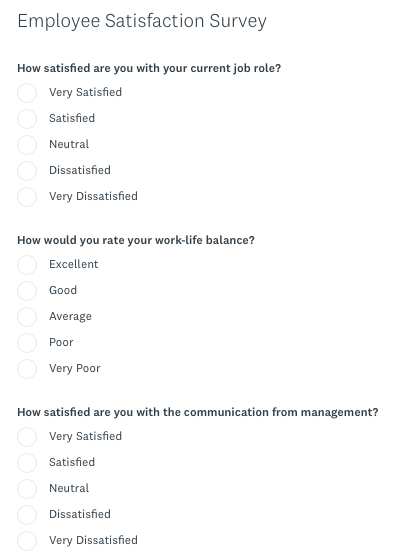
Employee satisfaction is an ongoing metric that drives business productivity and profitability. It is influenced by work-life balance, compensation and benefits, work environment, and professional development—nuances a single poll can’t capture.
Employee satisfaction surveys used long-term can help managers monitor employee happiness and identify challenges before they become major obstacles.
Choosing the right method
“A poll is to a survey what a quiz is to a test,” explains Wendy Smith, Senior Research Manager at SurveyMonkey. “A quiz reveals if you studied this week’s math lesson, whereas a test measures your overall mastery of the subject.”
Are you conducting a quiz or test? Consider the following factors:
- Depth of insight needed. Your choice between poll and survey is greatly determined by the feedback you seek. A poll captures a snapshot of sentiment without needing context—think “yes or no” or a simple preference. Surveys help you understand motivations, behaviors, and demographics with options for open-ended responses.
- Speed vs. accuracy. Is time of the essence, or do you have an extended timeline? Polls allow immediate feedback for low-stakes decisions. Surveys are preferable when you need accurate and statistically significant data more than speed.
- Complexity of topic. Polls work best when the topic is binary or has limited options. Surveys shine especially when a topic is nuanced or multifaceted, like a product development survey.
- Decision-making goals. Polls are great social-proof assessments. Surveys help build long-term strategies that require resources and investment, like customer feedback programs.
Poll or survey? Do both with SurveyMonkey
Poll and surveys are both effective tools for learning more about your audience, offering varying levels of depth and engagement. A poll offers a streamlined way to capture immediate, high-level sentiment on a single topic, whereas a survey provides the space needed to explore complex motivations and demographic trends.
By selecting the method that aligns with your specific goals, you can gather the precise data necessary to make informed, strategic decisions.
Poll or survey, SurveyMonkey can help you gather invaluable feedback with quick-deploy survey templates and market research solutions. Get started for free today.
Net Promoter, Net Promoter Score, and NPS are trademarks of Satmetrix Systems, Inc., Bain & Company, Inc., and Fred Reichheld
Discover more resources

Solutions for your role
SurveyMonkey can help you do your job better. Discover how to make a bigger impact with winning strategies, products, experiences, and more.

Anonymous polls: What they are, benefits, and how to create them
Learn what anonymous polls are, why they matter, common use cases, and how to create them effectively for honest feedback.

Trend forecast: What's shaping brands, AI and workplaces
Learn the top 5 trends driving business in 2026

Travel survey questions: 40+ examples to improve guest and traveler feedback
Use these 40+ travel survey questions and templates to collect feedback, boost guest satisfaction, and improve every traveller’s experience.