How to calculate your NPS® (Net Promoter Score®)
What’s your Net Promoter Score®? Use our NPS calculator and guide to measure, interpret and scale your customer loyalty.

If you want to understand the true depth of your customer loyalty, the Net Promoter Score® (NPS) is the industry standard. Use our NPS calculator to get a high-level view of how your brand is perceived and benchmark your score against our global standard.
NPS Calculator
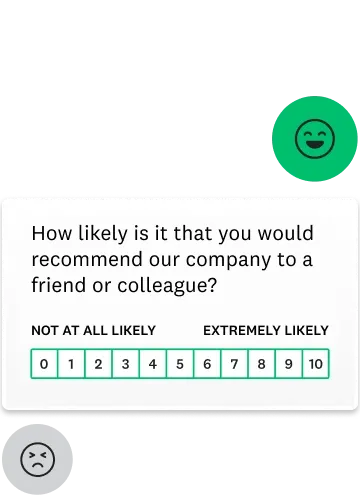
Your score comes from the Net Promoter Score question, which typically takes the following form:
“How likely is it that you would recommend (name of organisation, service or product) to a friend or colleague?”
The question prompt should be followed by a rating scale asking the respondent to select a number from 0 (least likely to recommend) to 10 (most likely to recommend).
Depending on the number that each customer selects, we’d group them into one of three groups:
- Promoters are customers who select a 9 or 10 rating. This group represents your most satisfied customers, who are highly likely to recommend your services to others.
- Passives are customers who select a 7 or 8 rating. This group is relatively satisfied. However, they could choose a competitor based on price, new features, customer service or other factors.
- Detractors select a rating between 0 to 6. They’re your least content customers. They are at risk of leaving and sharing their negative experiences with others.
Why use the NPS?

The NPS is the world’s leading metric for measuring customer loyalty and satisfaction.
Here are three main benefits of using the NPS:
- Scale: You can easily collect scores at scale. By asking customers the Net Promoter Score question, you can quickly receive feedback from a large share of your customer base.
- Scope: You can track the score over time. Is your score going up or down? Understanding its trajectory and what influences it can help your organisation focus on the areas that matter most to your customers.
- Focus: It helps you identify and focus on initiatives that drive customer retention and growth. When customers are successful, so are you.
This is only a fraction of the benefits of using the score. To learn more, read our guide to using NPS surveys to create the best customer experience.
How to calculate NPS
To calculate your Net Promoter Score (NPS):
- Start by collecting all your survey responses in one place, such as a spreadsheet.
- Categorise each respondent based on their score, and count how many fall into each category:
- Promoters (9–10)
- Passives (7–8)
- Detractors (0–6)
- Then calculate the percentage of promoters and detractors by dividing each count by the total number of responses and multiplying by 100.
- Finally, subtract the percentage of promoters from the percentage of detractors using the formula:
- NPS = % Promoters − % Detractors.
Here's an example:
If 50% of your respondents are promoters and 10% are detractors, your NPS would be 50 − 10 = 40. NPS scores range from -100 to 100, with higher scores indicating greater customer loyalty.
NPS calculation: an example
Once all your responses are in, you can work out your score using the following Net Promoter Score calculation:

To help you understand this formula, let’s walk through a brief example. Let’s suppose you’ve collected 150 responses to your NPS question. The distribution of the scores looks like this:
- 80 customers gave a rating of either 9 or 10.
- 30 customers gave a rating of either 7 or 8.
- 40 customers gave a rating of between 0 and 6.
This means you have 80 promoters, 30 passives and 40 detractors. To calculate the percentage of promoters, use the following formula:
% of promoters = (No. of promoters / No. of respondents) x 100%
To find the percentage of detractors, use the same formula. Just substitute the total number of promoters for the total number of detractors.
This means you have 80 / 150 * 100% = 53% promoters, while your percentage of detractors is 40 / 150 * 100% = 27%.
Subtracting the percentage of detractors from the percentage of promoters gives you the Net Promoter Score:
53% – 27% = 26%, i.e. an NPS of 26.
You’ll notice that the score is positive. This isn’t always the case. Net Promoter Scores can range from -100 to 100, depending on the scores and distribution.
Find out your NPS score
Use our NPS survey template, and we’ll automatically calculate your score. See how you compare to other businesses using our global benchmarks.
What’s a good Net Promoter Score?
A ‘good’ score is hard to pin down. Unfortunately, there isn’t a one-size-fits-all answer. Scores can vary dramatically depending on factors such as industry and company size. This means that you’ll need to benchmark your score against competitors that are similar to your organisation to truly find out where you stand.
SurveyMonkey Benchmarks can help you do just that. When you use SurveyMonkey to ask an NPS question, the platform automatically calculates your Net Promoter Score and allows you to compare it to other companies of your size in the same industry.
NPS benchmarks
You can compare your NPS to industry averages or competitors to see how your company is doing.
NPS benchmarks vary according to the industry. Some sectors have a much higher proportion of happy customers, so you should expect inflated figures if you work in this industry.
Here are some business-to-consumer (B2C) NPS benchmarks by industry:
| Industry | Benchmark (2024 data) |
| Insurance | 71 |
| Ecommerce | 62 |
| Retail | 61 |
| Financial services | 56 |
| Healthcare | 38 |
| Communications & media | 29 |
| Internet & software services | 4 |
Here are some business-to-business (B2B) NPS benchmarks by industry:
| Industry | Benchmark (2024 data) |
| Consulting | 68 |
| Technology & services | 61 |
| Digital marketing agency | 60 |
| Construction | 45 |
| Logistics & transportation | 43 |
| B2B software & SaaS | 40 |
| Cloud & hosting | 25 |
If the NPS of your business falls below your industry average, you should aim to improve it. You know you’re doing something right if you’re above average!
Types of NPS surveys
What is a transactional NPS (tNPS)?
A transactional NPS focuses on certain customer interactions, generating data immediately after a customer engages with a certain part of your business. For example, you could send out a tNPS survey straight after a customer does the following:
- Purchases a product
- Ends a support call
- Leaves feedback
Automating these at various points in your customer journey will allow you to gather specific NPS data. Calculating and interpreting your NPS from tNPS surveys will generate feedback about what’s working and what you could improve.
A higher tNPS suggests that a particular function or transaction is intuitive for customers. If you receive a low tNPS, you can highlight that your business needs to make a plan to work on this function or transaction.
What is a relational NPS (rNPS)?
A relational NPS is a more general style of NPS survey that aims to reveal overall customer sentiment. It will help your business measure customer loyalty and how customers feel about your company over time.
For example, you could send out rNPS surveys to measure the following:
- Overall customer satisfaction with your brand
- Customer reactions to a product or service
- How customers feel about a specific department
A relational NPS survey will help gather customer sentiment and is useful for tracking changes over time.
A higher rNPS suggests that customers are very satisfied with the aspect you’re exploring. On the contrary, a lower figure will help identify pain points in the customer journey.
How to interpret your NPS
Your NPS will be somewhere on a scale of -100 to +100. As scores go further down the scale towards -100, you will have more detractors. On the other hand, a high, positive number will suggest that you have more promoters than detractors.
The higher your number, the more of your customers love your brand. However, beyond this, you can also use different types of NPS surveys to generate even more information.
Let’s explore the different types of NPS respondents so you can interpret your score more accurately.
NPS detractors
NPS detractors are customers who have had a negative experience with your company. There are several reasons why someone may become a detractor, ranging from poor experiences with customer service to dissatisfaction with the quality of your products.
Considering that 89% of customer experience pros believe that the customer experience (CX) is the leading cause of customer churn, understanding how to get in touch with detractors is vital. Sending a personalised message to a detractor can be a great way of changing how they feel about your business.
The best practice when getting in touch with NPS detractors is to:
- Highlight the issue they raised.
- Acknowledge their opinions as valid.
- Outline the steps your business will take to remedy their problem.
- Give a rough timeline of how long you expect this process to take.
This approach, although short and sweet, will show the detractor that you care about their feedback. While this won’t satisfy everyone, it could be a big step towards turning an NPS detractor into a promoter.
Related reading: How to follow up with NPS detractors, promoters and passives
NPS promoters
NPS promoters are the direct opposite of detractors in that it’s likely that they’ve had one or more great experiences with your company. Having responded with either 9 or 10, it’s likely that they are loyal supporters of your business.
Thanking promoters for their support is always a great idea. Sending out a small, personalised message will show customers that they’re right to have confidence in your company. SurveyMonkey research reveals that 72% of customers believe personalised messaging is important when thinking of brands they love. You should make sure you address their comments directly and use their name.
When getting in touch with NPS promoters, you can also outline potential pathways that they could use to refer a friend, give public feedback or recommend your company to a colleague. As promoters already like and trust your brand, they are highly likely to recommend you to someone else.
Don’t overlook the power of word-of-mouth marketing.
NPS passives
NPS passives haven’t yet formed a strong opinion of your business. Maybe they haven’t had many interactions yet or they’re still undecided. Although many companies overlook passives, they can be a huge asset, as you can aim to turn them into promoters.
It’s much harder to change a detractor to a promoter, as you’ll have to undo their negative opinion of your business and convert it into a positive one. With NPS passives, you’re starting with a clean slate, where no customer has a previous strong opinion of your company.
Getting in touch with passives can help build rapport with this group and improve their opinion of your business. Respond to any feedback that they’ve left by outlining that you’re thankful for their support. If they’ve suggested an area where you could improve, carefully detail how you’re going to fix the problem.
NPS survey best practices and quick tips
The NPS survey is internationally renowned for its effectiveness. But to get the most out of this customer experience survey, make sure you follow our NPS best practices to improve response rates and generate more data:
- Distribution: Select a distribution method that many of your customers actively use.
- Automation: Automate NPS surveys to send them after key milestones.
- Response: Always close the feedback loop and respond to NPS survey feedback.
- NPS trajectory: Set clear NPS goals, benchmark your progress and continuously collect data.
- Ask the right questions: Keep your NPS question simple, to the point and oriented to the data you want to collect.
By following these best practices, you’ll ensure that your NPS surveys collect useful data that you can convert into actionable insights, thus quickly improving CX.
Get more from your NPS surveys
Calculating your NPS score will give your business insight into how your customers perceive you, your products and your support teams. But the story doesn’t end after using an NPS calculation and finding out your score.
Leveraging NPS, you can build an action plan to improve your processes and offer a winning customer experience across all touchpoints. Read more about how you can use NPS surveys to create the best customer experience, or get started with a free SurveyMonkey NPS template.
Want to improve your score?
Customise our NPS template to suit your product offering or to ask additional questions in order to understand your customers even better.
NPS, Net Promoter and Net Promoter Score are registered trademarks of Satmetrix Systems, Inc., Bain & Company and Fred Reichheld.
Discover more resources

Solutions for your role
SurveyMonkey can help you do your job better. Discover how to make a bigger impact with winning strategies, products, experiences and more.

Hornblower enhances global customer experiences
Discover how Hornblower uses SurveyMonkey and powerful AI to make the most of NPS data, collect customer insights and improve customer experiences.

Ultimate customer satisfaction guide: 8 tactics for improvement
What is customer satisfaction? Read our complete guide to discover what customer satisfaction is, how to measure it and eight strategies for business success.

A Guide to the Customer Effort Score (CES): What It Is and How to Use It
Learn how to measure customer satisfaction and experience using the customer effort score (CES). This guide explains what you need to know.