AI reshaped both business operations and how consumers interact with brands in 2025—and it looks like these changes are here to stay.
As adoption continued to accelerate across every sector, we saw organizations race to explore how AI capabilities can boost efficiency and create a tangible competitive advantage. But while businesses explored the new technology, not everyone was on board with AI use.
Consumers became wary of its presence when interacting with brands, and employees—many of whom lacked proper training—raised data security concerns.
Below, we break down key statistics from 2025 on:
- AI adoption rates
- Trust and transparency concerns
- Readiness gaps
- The attitudes of different generations.
You’ll also find our practical tips for businesses looking to balance AI efficiency with consumer expectations and growing ethical concerns.
Why AI mattered to businesses and employees in 2025
AI became a core strategic focus sector-wide in 2025. With technology advancing at such a rapid rate, competitive pressure increased as businesses sought AI-based market advantages.
For marketing, sales, and customer experience, AI became a tool for speed, efficiency, and data-driven insights.
Our 2025 State of Marketing report exemplifies the shift. Marketing teams noticed the positive impacts of AI adoption, with 93% of those who had used AI in content workflows reporting improvements. 62% also reportedly are optimistic that AI’s content generation will continue to improve, according to the same report.
However, the same report revealed concerns about AI’s efficiency in other areas of a marketing team's work. Over half (52%) felt they understand their target audience better than AI does and a further 4 in 10 were cautious about its use for customer-facing content, with 38% rating it as ‘fair’ or ‘poor’ at personalization.
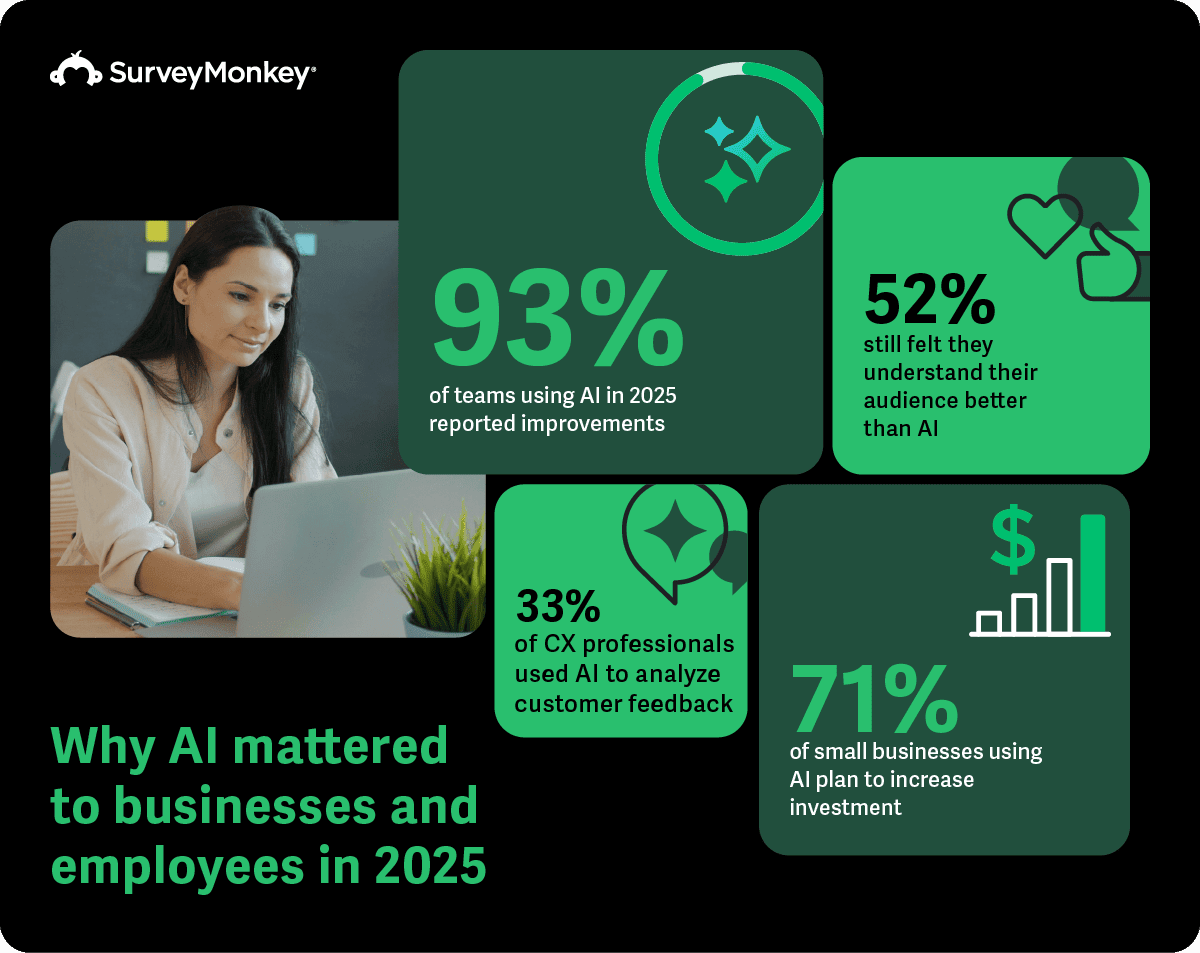
When it comes to customer experience (CX) professionals, 1 in 3 used AI to analyze customer feedback.
Among small businesses, investment momentum was strong, although adoption levels varied significantly depending on company size and resources. According to data from the Q3 2025 CNBC|SurveyMonkey Small Business Confidence Index, 37% of small businesses use AI—with 71% of those planning to increase investment. The study also revealed that 54% of small businesses using AI claim that it led to, or may lead to, job losses.
Summary
What’s clear is that AI is here to stay, so conversations around its role in strategy business-wide are crucial. Although adoption rates vary, businesses of all sizes should address the ongoing balance between efficiency gains and employment considerations.
What did consumers think about AI in 2025?
In marketing and customer experiences, customers were quick to notice AI, but often struggled to see how it enhanced their interactions with a brand. Many were pragmatic about their own AI use, finding certain tools convenient, while remaining cautious about reliability and value.
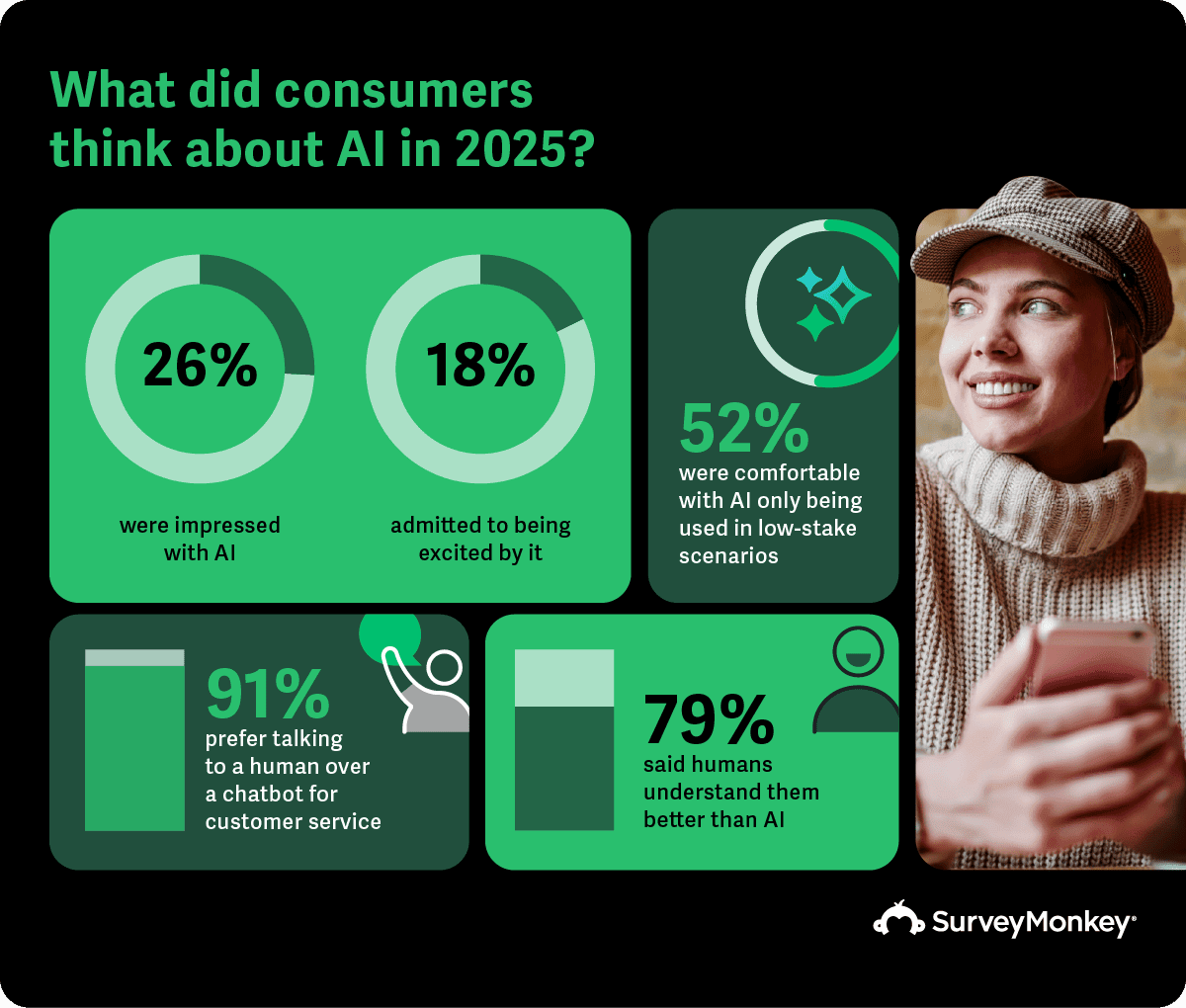
Our Q3 2025 AI Sentiment study showed this pragmatism was evident in comfort levels: consumers were comfortable with AI in lower-stakes situations, such as 55% being okay with an AI agent taking their order at a drive-thru. However, comfort plummeted when the stakes were high, with only about a third comfortable with a doctor using AI to personalize medical advice (33%) or HR using it to scan resumes (34%). Furthermore, Q1 2025 AI Sentiment data showed skepticism and concern were the leading sentiments toward AI (both 28%), compared to only 26% who were impressed and 18% who were excited. The majority of Americans who saw AI having an impact felt it would be a mixed bag of both positive and negative effects (38% in
Only a third of consumers used AI more personally in 2025, and just 19% were excited about it. This cautious sentiment was reflected in customer service preferences: while 44% of consumers preferred self-serve options when making purchases, when they needed help, they overwhelmingly wanted to talk with a person. In fact, a further 9 in 10 people (91%) preferred an employee to a chatbot when they called a customer service line, driven by the belief that 79% of consumers said a human understands them better than AI.
Yet, it’s worth noting that the number of Americans using AI on a daily or weekly basis rose to 31% in 2025 (from 24% in 2024). When it comes to products with AI capabilities, less than a third of consumers (27%) said these features make a product more appealing, according to our 2024 survey on generational AI use.
In relation to search, consumers thought AI is convenient, but not trustworthy. While AI can simplify processes like search, doubts around trust and accuracy persist, leading users to double-check or question results.
Summary
Overall, consumers viewed AI as useful but not yet consistently credible or confidence-inspiring. Brands need to emphasize transparency, reliability, and tangible benefits if they want to build trust with their audience.
Workplace readiness and AI literacy
We’ve established that businesses are keen to leverage artificial intelligence to cut costs and increase profits, but how capable are business professionals at using AI?

Our Q3 2025 AI Sentiment Study found that only 13% of American workers said that their company offered them any AI training.
Interestingly, our 2025 Workplace Culture and Trends report revealed that 29% of employees admitted to using AI to do their work without telling their manager, and 23% used it without explicitly notifying customers or users. In terms of the models used:
- 61% of AI users operated standalone tools like ChatGPT
- 45% used AI integrated into tools they already had
- 23% used AI solutions custom-built for their company.
In all, 84% of professionals had seen some benefit from using AI. Of this group, 53% said it helped them work more efficiently, 48% said it improved the quality of their work, and 47% said it helped them generate new ideas.
That said, the same research suggests that people worry about the data security and privacy of AI tools used at their company (54%), as well as the AI tools incorporated into their company’s products or services (57%).
Significantly, just 39% of professionals said their company took steps to address concerns around AI.
Summary
Workforce readiness for AI presents a mixed picture. Many leaders believe their teams are equipped to use this technology, particularly in marketing and customer-facing functions, but confidence varies across departments and isn’t always matched by consistent training.
Generational differences in AI adoption in the workplace
In the time that’s elapsed since our 2024 AI Trends by Generation study, the percentage of Americans who believe AI will have a major impact on their lives in the next 5 years has risen from 52% to 59%.
Our Q3 2025 AI Sentiment data showed that 43% used AI for work or professional purposes, up from 37% the previous quarter. And it’s clear that an increasing number of people, across all age groups, are using AI for work. Around a third (31%) of Gen Zers used AI for work or professional tasks (up from 27% the previous quarter), as did 36% of Millennials (up from 31%), and 19% of Boomers/Silent Generation (up from 13%).
In 2024, Gen Z were the biggest users of AI for education, with 61% using it for school or other learning.
Personal assistance applications of AI—including automating basic tasks like scheduling and reminders—bridged the generation gap, with all ages showing consistent adoption of up to 41-48%.

In the workplace, 82% of Gen Z/Millennial marketers said AI helped them meet key metrics, and 66% were confident in using AI for customer-facing content, compared to 56% of Gen X.
Overall, Gen X (53%) and Millennials (50%) were the most likely to use AI for work.
Last year, about 24% of each generational group said they’re impressed by AI, and 27% remain skeptical.
Generational differences highlighted how AI perception varies depending on context and need. Gen Z is at the forefront of using AI for education, embracing it as a learning tool, while Millennials and Gen X lean more heavily on AI for professional purposes.
Older generations remain far more resistant, particularly when it comes to customer service, where the preference for human interaction is overwhelming. Even among younger groups, openness to AI-led support is limited, indicating a shared discomfort with replacing human connection in sensitive or service-driven contexts.
Summary
Across all age groups, AI sentiment remains relatively consistent: a mix of curiosity and skepticism, with only a few expressing strong enthusiasm. This suggests that while patterns of use differ by generation, people remain cautious across the board.
Consumer views on data privacy, disclosure, and ethics in 2025
It’s clear that consumers had concerns around AI usage in 2025, and this is certainly true in relation to how their data is used.
Consumers increasingly expect companies to treat privacy as an ethical commitment, not just a regulatory obligation. This means leading with integrity and ensuring that AI governance strategies maintain crucial human oversight. When consumers assume their data is being used to train AI models, they are implicitly demanding that a human be accountable for that process and the resulting outputs.
Trust and transparency evidently remain central to how consumers evaluate AI in brand interactions. And as most people assume their personal data is being used to train AI systems, clear and honest disclosure is more important than ever.
Consumers increasingly demanded transparency. In a recent study by Emplify, two-thirds (60%) of US consumers agree that companies should disclose when they are interacting with AI. For the business, empowering users with meaningful control—such as simple opt-out mechanisms or clearly written policy pages—is a non-negotiable for sustaining that trust. Companies that are proactive and transparent in their data practices are not only mitigating reputational risk but are also building a tangible competitive advantage.
Summary
Together, these attitudes highlight the reputational risks for businesses that fail to address consumer concerns adequately, and the opportunity for those that lead with openness, clarity, and respect for customer choice.
Practical steps for businesses
Businesses using AI need to respect consumer desires for authentic communication and honest disclosure when using AI to streamline processes.
This technology may provide tempting shortcuts, but it’s key to stay focused on the consumer and their experience.
With this in mind, here are some practical steps that organizations utilising AI should take to balance business advantage and customer experience:
1. Disclose where and how AI is used
Organizations wanting to build or retain trust with their customers must be transparent about where and how they’re using AI.
Consumers are increasingly AI-savvy and will only become better at recognizing it in their emails, advertising, and customer service touchpoints.
Businesses should explain how AI is used in customer interactions and properly notify them of any material produced by AI to maintain trust. Customers will likely learn more and develop closer bonds if organizations help them to understand how AI might enhance their experience. By proactively revealing the use of AI, businesses can help consumers feel informed and valued.
2. Prioritize customer empathy and human touch
If AI can enhance a customer’s experience, that’s great—but this isn’t always the case. Nine in 10 people would rather speak to a human than a chatbot when they call a support line, for example, so each step of the customer journey should be plotted out with care.
This proves that human interaction will always be vital to consumers. In light of this, organizations need to remain empathetic when designing AI strategies. Businesses must ensure the human touch is present when providing products or services to their customers.
3. Close workforce training gaps
AI training in businesses is inconsistent and in some cases nonexistent, so companies wanting to thrive should address this urgently. Using templates like these, businesses can assess their current workforce capabilities before identifying critical skill gaps across teams.
From this, companies can begin prioritizing training initiatives for relevant roles or those underskilled in AI. This could be particularly helpful for small businesses. Structured programs like workshops, online learning resources, or mentorship can help employees adopt AI responsibly, boosting productivity and ensuring data is handled correctly.
By taking these steps, businesses not only close training gaps but also create a confident, capable workforce ready to leverage AI effectively.
4. Segment AI strategies across demographics and geographies
Businesses need to tailor AI strategies for different demographics and geographies because comfort levels and preferences vary significantly among different consumer groups.
Cultural attitudes toward AI differ across regions and countries, meaning businesses should conduct market research to understand how their specific customer segments feel about its use in different contexts, and offer choices where possible, such as opt-in AI features or easy escalation to human representatives.