The best decisions come from understanding not just what people like but also what they value most.
For example, if your company is planning an office event but isn’t sure which option employees prefer, a ranking survey question can help. Unlike rating scales or multiple choice questions, ranking forces respondents to prioritise their choices.
Let’s suppose that HR presents three options: (a) a lunch and learn; (b) a sponsored walk; and (c) a mindfulness session. By asking employees to rank these in order of preference, you’ll discover which event they truly value rather than the one they would simply be prepared to tolerate.
Are you curious about how ranking questions work? If so, read on for tips, best practices and 30+ examples for marketers, researchers and HR professionals.
What is a ranking survey question?
A ranking survey question asks respondents to rank choices from most to least preferred, revealing how they prioritise options relative to each other.
This type of survey question is ideal when you need to force a choice. Ranking questions differ from multiple choice and rating questions because they don’t offer a ‘neutral’ or ‘neither agree nor disagree’ answer option.
Ranking questions are commonly used in market research, customer satisfaction surveys and employee feedback surveys.
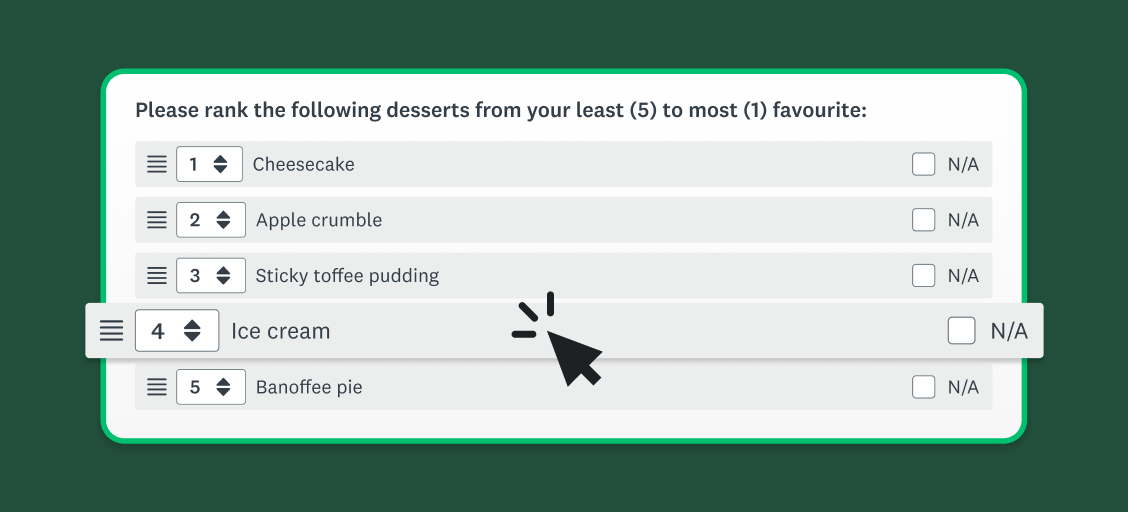
For example, in the image below, respondents rearrange the options to reflect their preferences.

It’s important to note that ranking questions should only be used when you know people will have an opinion about the options. For instance, a person with gluten intolerance may not be able to eat most of these dessert options, which can affect the results.
Related: Ranking vs. rating explained
30+ examples of ranking survey questions
Whether you’re a market researcher, employer, educator or business owner, these questions can offer valuable insights when used strategically. To help illustrate their versatility, let’s look at sample ranking questions tailored to each of the categories below.
Related: How to create a ranking question
Deploy surveys with SurveyMonkey now
Create your own ranking survey questions, or save time and use our expert-written survey templates for actionable insights now.
Ranking questions for market research
- Rank the following product features in order of importance to you:
- Price
- Durability
- Brand reputation
- Eco-friendliness
- Design
- Rank the following reasons for purchasing a product like ours:
- Peer recommendations
- Online reviews
- Social media ads
- In-store displays
- Rank the following packaging elements according to their influence on your buying decision:
- Colours
- Sustainability
- Size
- Visual design
- Rank the following promotional methods according to what gets your attention most:
- Email newsletters
- Social media ads
- TV/radio ads
- Rank the following pain points in your shopping experience:
- Long checkout times
- Poor customer service
- Limited payment options
- Awkward returns process
- Rank the following sources of brand discovery according to how you first hear about new products:
- Word of mouth
- Social media
- Google search
- In-store experience
- Rank the following factors according to how likely it is that they would influence a repeat purchase:
- Product quality
- Customer service
- Consistent pricing
- Dispatch/delivery experience
Ranking questions for employees
- Rank the following job benefits according to their importance to you:
- Private health insurance scheme
- Remote-working flexibility
- Paid leave/holiday leave provision
- Company pension scheme
- Rank the following sources of workplace stress:
- Lack of resources
- Poor communication
- Unclear expectations
- Rank the following aspects of your team environment according to their importance:
- Collaboration
- Trust
- Communication
- Accountability
- Rank the following leadership traits in order of importance:
- Transparency
- Empathy
- Strategic thinking
- Delegation skills
- Approachability
- Rank the following tools or systems that you use daily according to their usefulness:
- Project management software
- Internal chat tools
- File-sharing platforms
- Rank the following factors according to what motivates you most at work:
- Recognition from leadership
- Bonuses or pay rises
- Team success
- Rank the following aspects of workplace culture according to their influence on your job satisfaction:
- Inclusivity
- Clear communication from leadership
- Career-advancement opportunities
- Work-life balance
- Team camaraderie
- Rank the following communication methods according to how effective they are for staying informed at work:
- Team meetings
- One-to-one check-ins
- Company-wide emails
- Internal chat platforms
Ranking questions for teachers
- Rank the following student engagement methods according to their effectiveness in your classroom:
- Group activities
- Visual aids
- Technology integration
- Open discussions
- Rank the following challenges you encounter in your teaching:
- Student attention span
- Parental involvement
- Curriculum changes
- Classroom size
- Rank the following learning outcomes according to their priority:
- Critical thinking
- Teamwork
- Creativity
- Test performance
- Rank the following classroom tools according to their usefulness:
- Interactive whiteboards
- Printed textbooks
- Flashcards
- Rank the following professional development needs in terms of your teaching:
- Classroom management
- Subject-specific knowledge
- Technology training
- SEN support
- Rank the following parent-teacher communication methods according to their effectiveness:
- Phone calls
- Parents’ evenings
- Newsletters
- Rank the following student qualities according to their impact on classroom learning:
- Participation
- Preparedness
- Respect for peers
- Active listening
Ranking questions for customers
According to Forbes, 85% of customers in the US are willing to go out of their way for better service. To validate this for your customer base, you could ask this ranking question:
- Rank the following from most important to least important for your shopping experience:
- Convenience
- Great service
- Price
- Brand
Additional customer ranking question examples:
- Rank the following support channels in order of preference:
- Live chat
- Phone support
- Help centre/FAQs
3. Rank the following reasons for you choosing a specific brand:
- Product quality
- Loyalty rewards
- Customer service
- Brand values
4. Rank the following dispatch/delivery factors according to their importance:
- Quick dispatch/delivery
- Free delivery
- Easy tracking
5. Rank the following shopping frustrations:
- Poor mobile experience
- Complicated checkout process
- Limited payment options
- Out-of-stock items
6. Rank the following loyalty scheme features according to how likely it is that they will encourage you to sign up:
- Points earned for purchases
- Birthday rewards
- Exclusive discounts
- Early access to products
7. Rank the following email types according to which ones you’re most likely to open from a brand:
- Order updates
- Loyalty programme reminders
- Personalised recommendations
8. Rank the following website features according to what improves your shopping experience most:
- Clear product images
- Easy navigation
- Product reviews
- Mobile responsiveness
Benefits of ranking questions
Ranking survey questions offer valuable insights by helping you to discover people’s genuine priorities and make meaningful comparisons. Read on to discover the key benefits of using this question type in your research.
Helps you to identify genuine priorities
Ranking questions are incredibly helpful for uncovering survey-takers’ true priorities and preferences. By asking participants to rank items, you are prompting them to make direct comparisons and thus revealing what matters most.
For example, you could ask employees to rank team-building activities according to their level of interest. This allows you to identify the most consistently preferred option, enabling you to confidently select an activity that aligns with the team’s preferences.
Enables better decision-making
Ranking questions are a powerful tool for decision-making, especially if the top choices are equally popular. If you’re deciding between two or three leading options, asking respondents to rank them forces a clear preference, revealing which option truly stands out.
By asking survey-takers to rank a short list of options according to their preference, you will gain sharper insights into what matters most, helping you to make more confident, data-driven decisions.
Reduces response bias
Response bias occurs when respondents answer questions inaccurately, often due to social pressure or the desire to give a more acceptable response.
This is a common occurrence for questions about personal habits or opinions. For instance, someone may under-report how often they drink alcohol in order to be perceived as more socially responsible.
Minimising response bias is essential for collecting reliable data. Survey ranking questions help to reduce this bias by prompting respondents to make relative judgments rather than selecting a single, potentially ‘correct’ answer.
When they compare multiple items, it’s more likely that participants will reveal their true priorities, leading to more honest and unbiased insights.
Generates clear, comparative insights
Another key benefit of ranking survey questions is their ability to produce clear, comparative insights. By asking respondents to rank items according to preference, importance or frequency, you can clearly see how different factors measure up against one another.
Ranking responses reveal which options consistently rise to the top or sink to the bottom, helping you to uncover audience priorities, emerging trends and perception gaps.
This clarity supports more informed, data-driven decisions focused on what truly matters to your target audience.
Helps you to understand preferences
Ranking survey questions are a powerful way to uncover preferences and spot patterns in respondent behaviour.
Unlike multiple choice questions, which capture only a single selection, ranking questions reveal the full order of preference, giving you deeper, more nuanced insights into what your audience values most.
This makes them especially useful when you need to understand not only what people choose but also how they prioritise their options.
When to use ranking questions
Ranking questions should be used sparingly to maintain their effectiveness, according to SurveyMonkey Research Scientist Wendy Smith.
“It’s a modern approach, but it’s more restrictive than choice modelling,” says Smith. “It’s a forced-choice question. You are getting the top stated choice, but that choice may not reflect true feelings.”
Survey ranking questions work best when you are looking for relative preferences. For example, if you want to find the top two dessert choices for an office party, a ranking question helps you to identify the favourite and the runner-up.
Survey ranking is also great if a set group of items that people have an opinion about tie for top position. As long as the question pertains to something that people will have an opinion about, it should work effectively.
Here are a few specific scenarios when you might choose to use a ranking survey question:
- Product feature prioritisation. When you’re developing or improving a product and want to know which features users value most, ranking helps you to distinguish between what they consider to be must-haves and what they consider to be desirable.
- Event planning preferences. If you’re organising an event and want to gauge interest in different activities, food choices or dates, a ranking question helps you to understand which options are most appealing to your attendees.
- Customer experience evaluation. To assess which factors matter most in a customer’s experience (e.g. price, speed, support, ease of use), ranking allows for more accurate prioritisation than individual rating scales.
- Employee feedback. To guide internal improvements, ranking questions can help you identify which aspects of workplace culture, benefits or tools employees value most.

Types of ranking questions
Ranking questions come in several formats, from simple rank order to interactive drag and drop. Understanding these different approaches can help you to choose the right format for your goals. Let’s now explore each one and when to use it.
Forced ranking
Forced ranking questions require respondents to assign a unique rank to each item in a list, with no ties allowed. This approach encourages clear distinctions in terms of preference or importance. It helps to reveal true priorities and resolve ambiguous feedback, especially when definitive choices are needed.
Partial ranking
Partial ranking asks respondents to rank only a select number of items from a larger list, such as choosing their top three favourites out of ten options. This approach reduces cognitive load and prevents respondents from ranking items that they may not know or care about.
Pairwise comparison
Pairwise comparison presents respondents with two options at a time and asks them to choose their preferred one. This process repeats across all possible pairs in the set, revealing relative preferences through direct, head-to-head comparisons.
Image ranking
Image ranking uses visuals instead of text as response options, allowing respondents to rank images according to preference or appeal. For example, a logo testing survey might ask customers to rank logo concepts from best to worst, making this method especially valuable for marketing teams’ testing.
Drag-and-drop ranking
Drag-and-drop ranking enables survey respondents to reorder options by dragging them into their preferred sequence, making the ranking process interactive, intuitive, quick and user-friendly.
Tips for writing ranking questions
Good survey design improves data quality. That’s why we’re sharing some tips for writing effective ranking questions.
Keep the list short
The list should comprise between three and five options to be ranked. You’ll need to keep your respondents’ attention and keep the list as simple as possible.
Use clear, comparable options
You should ensure that the options you choose are relevant, comparable and written clearly. Also, try to limit each option to as few words as possible; short phrases or single-word options are best.
Pre-test for comprehension
Sending your survey to a small sample before launching the official survey can help you to test the quality and effectiveness of your questions. Pre-testing alerts you if respondents find any of the questions confusing or too complicated.
Don’t overuse ranking in one survey
Ranking questions can be highly effective, but they shouldn’t be used excessively within the same survey as this may overwhelm respondents and cause survey fatigue. A good rule of thumb is to have no more than two or three ranking questions in a single survey.
Use digital tools that support the ranking UX
You’ll need to ensure that the survey builder you use supports a seamless user experience for ranking questions. SurveyMonkey offers ranking question formatting, allowing users to order options according to their preferences.
Create your ranking surveys with SurveyMonkey
Ranking survey questions can be incredibly useful for discovering people’s true preferences. Whether you’re hosting an employee movie night or evaluating product features, ranking questions can be helpful. This type of question encourages respondents to make a decisive and honest choice.
SurveyMonkey helps teams to use ranking questions to survey their target audiences. Create quizzes and surveys at the click of a button to gather valuable data with SurveyMonkey. Our survey and quiz maker enables you to create professional surveys with little effort.