Research polls: Use cases, sample size & best practices
Master the art of research polling to gain rapid, high-level insights into public sentiment and social trends.

Research polls serve as an essential, high-speed gateway to understanding the collective mind, offering a streamlined method for gathering actionable insights.
These tools empower researchers to gauge shifting public sentiment and accumulate high volumes of data with a level of efficiency that traditional methods simply cannot match.
This guide will explore the strategic implementation of research polls, detailing the core methodologies required to ensure accuracy and the critical role of sample size in validating your findings.
How to use poll data to conduct research
A research poll is a systematic method of collecting data by asking a specific set of questions to a sample of individuals to represent the views, behaviors, or characteristics of a larger population.
Research polls allow you to understand general social attitudes toward a topic. For example, you may conduct a research poll to gauge how Americans feel about the Winter Olympics.
On the other hand, market research surveys help you understand specific behaviors and trends. For instance, a survey might measure how many Americans watch the Winter Olympics compared to the Summer Olympics to identify viewership patterns.
Online polls are useful when you need quick insights or to conduct a pulse check on the general population.
Why use polls for research
Research polls serve as indispensable instruments for social and opinion research, offering a streamlined way to quantify the human experience. Here is a breakdown of why you should use research polls:
- Rapid data collection: Polls allow you to gather information from hundreds or thousands of individuals simultaneously, significantly outperforming qualitative methods like 1-on-1 interviews.
- Cost-efficiency: Compared to focus groups or longitudinal studies, digital polls require minimal overhead, saving on labor, travel, and physical materials.
- Seamless distribution: With modern tools, polls can be shared via email, social media, or QR codes, reaching diverse geographic locations instantly.
- Real-time results: Many platforms offer live dashboards, allowing researchers to monitor trends and analyze incoming data as soon as the first respondent hits "submit."
- Foundational discovery: They are ideal for early-stage or exploratory research, helping to identify broad patterns or "red flags" before investing in more intensive, deep-dive studies.
How to determine the right sample size for a research poll
In research polling, sample size is a critical metric because it determines the statistical confidence with which results can be projected onto a broader population.
Generally, as the sample size increases, the margin of error decreases, resulting in more precise and reliable data.
For instance, if a research poll finds that 95% of Americans drink coffee daily with a ±3% margin of error, one can infer that the true value for the entire population likely falls between 92% and 98%. This range represents the confidence interval, providing a clearer picture of the data's certainty.
To calculate your research poll sample size, use this standard sample size calculation formula for estimating:
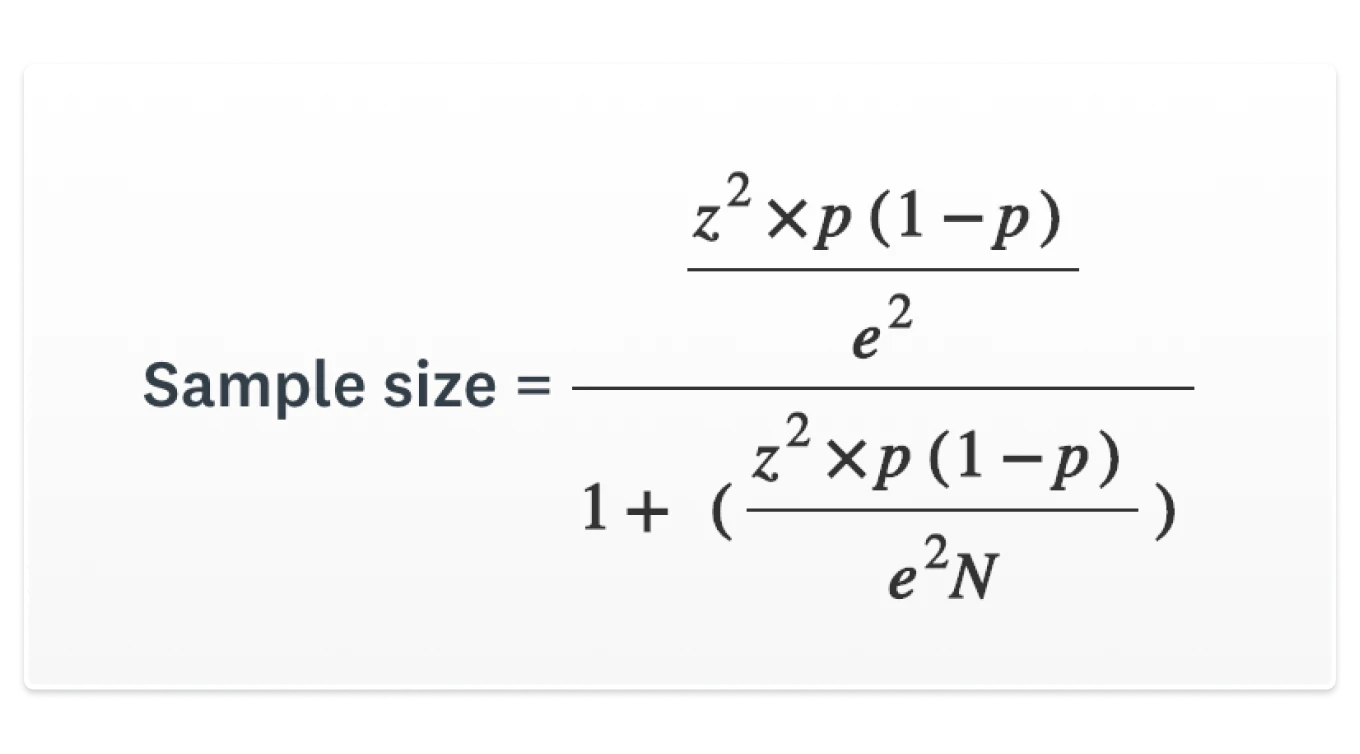
- n = required sample size (completed responses)
- z = z-score for your chosen confidence level (for 95% confidence, z = 1.96)
- p = expected proportion selecting a given answer (use 0.5 if you’re not sure)
- E = margin of error in decimal form (e.g., 5% = 0.05)
Poll research sample size example:
For instance, if your population is 10,000,000 and want a 95% confidence, a ±5% margin of error, and p = 0.5, the formula gives:
n≈384.16n \approx 384.16n≈384.16
You need 385 completed responses to estimate results for a 10-million-person population at those settings.
How to run an online poll for research using SurveyMonkey
1. Define your objective
The clarity of your objective is the primary factor in determining whether to deploy a research poll or a market research survey.
A research poll is the ideal instrument when your goal is to efficiently gauge broad public opinion or capture a snapshot of current sentiment on a specific issue.
Conversely, if your objective involves testing product concepts or analyzing consumer behavior patterns, a market research survey is the more appropriate tool.
While polls prioritize speed and singular focus, surveys offer the multi-dimensional data required to map out the entire customer journey.
2. Choose the right question types
Close-ended questions are the gold standard for research polling because they offer a fixed set of responses that facilitate rapid participant completion.
By limiting choices to specific categories, researchers can quantify responses in ways that are not possible with open-ended text.
This structured format not only drives higher completion rates but also ensures a cleaner, more actionable dataset.
3. Select a sampling method
A key distinction between academic research polls and general market research lies in the sampling method.
Research polls typically require random sampling, a technique where every individual in the population has an equal chance of selection to ensure the group is truly representative.
Using a random sample, you can statistically generalize your findings from a small group to the entire population. This allows for broader conclusions, such as stating that "95% of Americans" hold a certain view rather than limiting the claim to just the "95% of respondents who participated.”
4. Distribute your poll
Distributing your poll is critical to capturing an accurate pulse of the public. While traditional methods like mail-ins or phone banks are viable, they can be slow. If you need deeper, faster insights that truly reflect the general population, SurveyMonkey Audience is the superior choice.
With a global panel of over 335 million people across 130 countries and more than 200 targeting options, you can leverage advanced criteria to reach your precise audience with ease.
Related reading: Best practices and channels for sending surveys
Best practices for effective research polls
Designing a high-impact research poll requires more than just asking questions; it demands a strategic approach to structure and phrasing. Following these industry-leading best practices ensures your data is both statistically sound and practically actionable.
- Keep wording clear and neutral. Avoid leading or loaded language that nudges a respondent toward a specific answer.
- Ask one question at a time. Steer clear of "double-barreled" questions which confuse the data.
- Test your poll before sending. Conduct a "pilot test" with a small group to identify confusing phrasing or technical glitches.
- Ensure anonymity or confidentiality if needed: Participants provide more honest feedback when they know their identity is protected, especially on sensitive topics.
Start using polls in your research
Research polls are a simple, streamlined tool for collecting social attitudes and opinions.
To streamline this process, you can now leverage AI to build and deploy tailored polls in a matter of seconds. Experience the perfect balance of speed and sincerity by launching your first AI-driven poll for free today.
See how SurveyMonkey can power your curiosity
Discover more resources

Solutions for your role
SurveyMonkey can help you do your job better. Discover how to make a bigger impact with winning strategies, products, experiences, and more.

How to create a poll in a text message
From "sent" to "solved"—learn how to create a poll in a text message with SurveyMonkey that wins.

New at SurveyMonkey: AI summaries, smarter charts, and longitudinal analysis
The latest SurveyMonkey updates and features, including AI summaries, modernized charts, and longitudinal analysis.

Online Scheduling Poll Template
Use our Online Scheduling Poll Template to check availability and create a scheduling poll for your next meeting in minutes.