How to build a winning employee engagement programme
Spot disengagement early – before it erodes your culture – with a playbook backed by decades of employee feedback expertise.

With work-life balance a top priority for 61% of the workforce – and one in three younger workers rating their company’s growth and development opportunities as fair or poor – it’s a clear sign that organisations need to look beyond pay to provide the flexibility and growth that employees value (USA TODAY | SurveyMonkey Workforce Survey).
Closing gaps in the employee experience starts with having a clear plan. Follow our four-step playbook to move from baseline data to a fully operational engagement strategy in just 90 days.
Employee engagement programme: Your 90-day roadmap
Weeks 1–4 | Building the foundation
Pre-Launch alignment: Ensure leadership is fully aligned and create a clear communication strategy to set the stage for your programme’s success.
Employee engagement survey: Launch the annual survey to set your baseline. Offer anonymous responses to encourage honest feedback.


STEP 1
Establish an engagement baseline
Start with a survey to establish your baseline before you build an ongoing feedback loop to keep a pulse on engagement trends. Combine deep-dive surveys with quick, real-time pulse checks to get the full story behind your data, providing the agility to fix small issues before they become big ones.

Employee engagement survey
Use this annual survey to establish a baseline for what drives employee engagement across your organisation.

Culture pulse survey
Use this monthly check-in to get real-time feedback about a smaller set of metrics and evaluate how org changes impact employee sentiment. View template

Employee Net Promoter® Score (eNPS) Survey
Use this quarterly survey to get a standardised benchmark for your company’s cultural health.

Employee lifecycle touchpoints
Integrate lifecycle surveys – recruiting, stay and exit – with learning and development (L&D) surveys, AI readiness and scheduled pulse checks to visualise the entire employee journey.
The playbook in action: Unlocking honest feedback
YES Communities’ in-person exit interviews with managers stifled honest feedback.
They switched to emailing surveys to departing employees, ensuring candid responses.
STEP 2
Sample framework: Turning survey insights into action

While competitive pay might get talent through the door, long-term retention is built on growth opportunities, leadership skills and trust.
To build a workplace where people want to stay and grow, move beyond data collection and start driving results with this sample framework for turning feedback into action.
| Insight and risk | Goal and action plan | |
| Talent retention and mobility | Insight Only 48% of employees agree or strongly agree that they see a path to growth at the company Risk Attrition or quiet quitting | Goal Improve path-to-growth perception by 20 points to 68% Action plan Hold stay interviews and streamline the process for internal promotions |
| Strategic alignment | Insight 56% of teams don't see their work reflected in company priorities Risk Teams don’t move the needle on primary growth targets | Goal Achieve a 20-point boost in the number of staff who can link their daily work to company KPIs Action plan Anchor team goals to core KPIs and empower managers to veto work that doesn't drive key results |
| Support and benefits | Insight 35% of employees feel company benefits don’t meet their needs Risk Top performers leave for competitors who offer the flexibility and support they need | Goal Boost employee sentiment toward benefits by 25 points Action plan Optimise perks, like flexibility or wellness, based on feedback |
The playbook in action: Finding the root cause of turnover
The breakthrough for YES Communities came when they learned turnover wasn't a money problem, but an expectations problem.
Data showed that employees were leaving because the roles weren’t what they signed up for.
STEP 3
Create an employee engagement action plan

Now that goals have been established and data collected, it’s time to conduct analysis and act on your findings. A structured plan ensures that your insights lead to high-impact initiatives with clear owners and milestones.
Secure leadership buy-in
Align managers on goals and metrics so your overall vision resonates consistently across the company.
Tell a clear story
Create a communication plan that defines the plan’s purpose to ensure broad adoption and alignment.
Give managers the right tools
Enable department leaders to drive engagement with team-specific insights and customised action plans.
Target quick wins
Identify small, high-impact changes to show employees you’re actually listening.
The playbook in action: Closing the expectations gap
YES Communities transformed data into a retention roadmap, updating job descriptions and interviewer training to ensure the daily work experience matched the initial job pitch.
STEP 4
Track results and measure impact
Combine real-time tracking with continuous feedback loops to keep your strategy agile and aligned with your team’s evolving needs.

Track KPIs and engagement trends
Evaluate your results against initial benchmarks to identify recurring themes and measure overall improvement in employee sentiment.
Link sentiment to business outcomes
Connect high-level wins, such as increased retention or productivity, to specific engagement drivers, such as career growth or management support.
Pair data with qualitative feedback
Combine numerical scores with open-ended comments to capture the unfiltered sentiment that raw numbers might miss.
The playbook in action: Building a "stay" culture
YES Communities used targeted feedback to drive major improvements to the employee experience.
Tackling the root causes of early turnover helped them boost average retention from 90 days to a year and a half, which represents a six-fold increase.
It’s easy to launch an employee feedback programme, your way
Build it your way
Create your own custom employee engagement surveys, and join the 92% of users who say our powerful platform is easy to use.
Use ready-to-launch feedback programmes
Get a head start on your employee engagement strategy with made-for-you programmes that guide you with pre-built surveys, recommended cadences and connected insights.
Get expert help from our services team
Work with our team of experts who offer a range of support and services – from survey design to fielding to reporting – and get more out of your research efforts.
Your toolkit for a winning engagement strategy

Drive employee engagement and retention
Launch a continuous listening engine to spot risks, retain talent and prove the business impact of your employee programmes.

Boost engagement with these 6 employee feedback tips
Explore practical tips to drive growth, innovation and employee satisfaction.
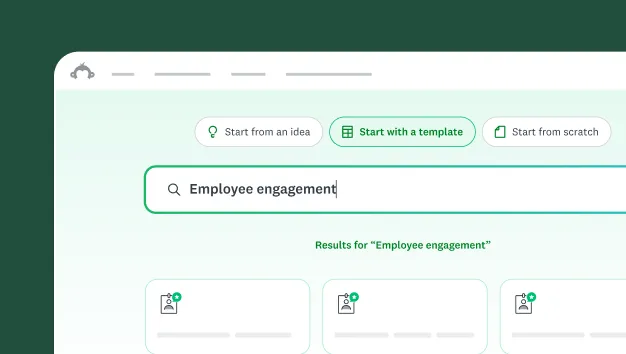
Start with expert-written employee engagement templates
Build your next employee engagement survey using templates that you can customise with ease.
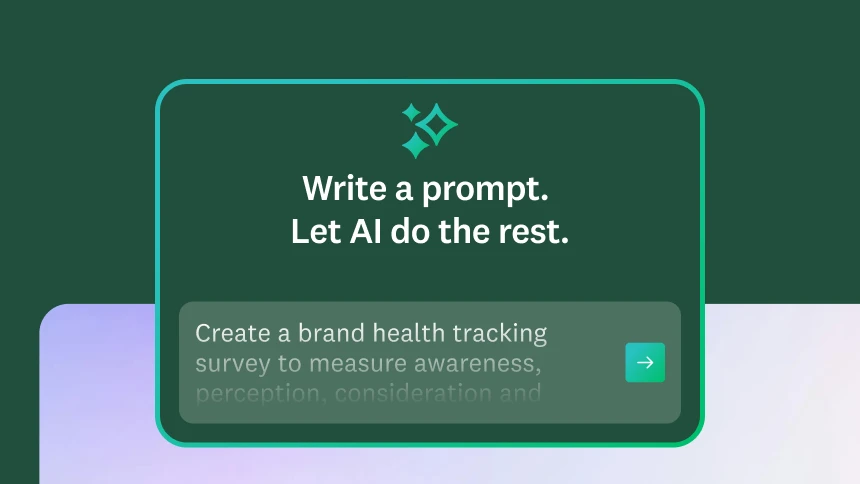
Create better surveys with AI
Create polished surveys using AI and get customised tips to improve your survey response rate.
SurveyMonkey solutions to support your workforce across the employee journey

Attract top talent and leave a positive impression on job seekers.


Have any questions? If so, we’re here with answers
- What is employee engagement?
- Why is employee engagement important for a company?
- How do I measure employee engagement?
- How can I increase employee engagement?
NPS, Net Promoter and Net Promoter Score are registered trademarks of Satmetrix Systems, Inc., Bain & Company and Fred Reichheld.