Market penetration: What it is, why it matters and how to calculate it
Discover what market penetration is, how to measure it accurately and proven strategies to grow your market share.

Every business aspires to become a market leader, but how can you know if you’re truly making an impact? Market penetration holds the key.
Market penetration measures how much your target audience is using your product or service. The higher the company’s market penetration, the larger its market share.
Companies monitor market penetration to gauge success, assess their market share and identify new opportunities for growth. In this article, we’ll explore the market penetration rate, how to calculate it and the best-proven strategies to boost your reach and help your business grow.
What is market penetration?
Market penetration refers to the percentage of your target market that has purchased or is using your product or service. It enables businesses to understand how much of the market they have captured and how they stack up against competitors.
Market penetration example
Consider this real-world market penetration example:
Imagine a coffee shop chain with 200 locations in a city of 2 million people. If the company has 500,000 customers, the market penetration rate would be 25%. This means that a quarter of the city’s population is already enjoying their coffee, while the remaining 75% of the market is still untapped.
By calculating market penetration, companies can identify growth opportunities and enhance their business strategies. For example, the coffee shop chain might consider applying market penetration strategies, such as competitive pricing, to boost both market share and current sales volume.
Understanding which market segments are already being served and which remain underrepresented helps companies adapt their growth strategies, enter new markets and boost sales.
Market penetration vs. market share
It’s important not to mix up market share with the market penetration rate. The concepts are certainly related, but they are also distinctly different.
In short, the difference between market share and market penetration is as follows:
| Market penetration | Market share | |
| Definition | Market penetration is the percentage of customers you reach at least once in a defined period of time. It is often calculated relative to a target market that can potentially be much smaller than the market as a whole. | Market share measures your company’s revenue as a percentage of total sales within a broader market or industry. It represents your slice of the market in terms of value, not just reach. |
| Example | You might say you have penetrated 15% of the market, which means that 15% of all the customers of products like yours have purchased from you. | If you’ve sold to 15% of the market, but those customers spend less with you than they do with your competitors, your market share by value may be considerably less than 15%. |
Both market penetration and market share are important, particularly when thinking about market development. Keep both in mind as you develop products, consider acquisitions and shape your overall marketing strategy.
How to calculate market penetration
Penetration rate in marketing is the percentage of the total target market that has purchased or used a company’s product or service. It reveals what portion of the target market is actively engaging with the brand and shows how deeply the product has penetrated the market.
Understanding your market penetration rate is essential because it provides a snapshot of your company’s market share, customer engagement and overall competitiveness. By monitoring this, brands can evaluate how effectively they’re reaching their market and spot new marketing opportunities.
The formula for calculating market penetration is simple.
Formula: Market penetration rate = (Current customers / Total target market) x 100
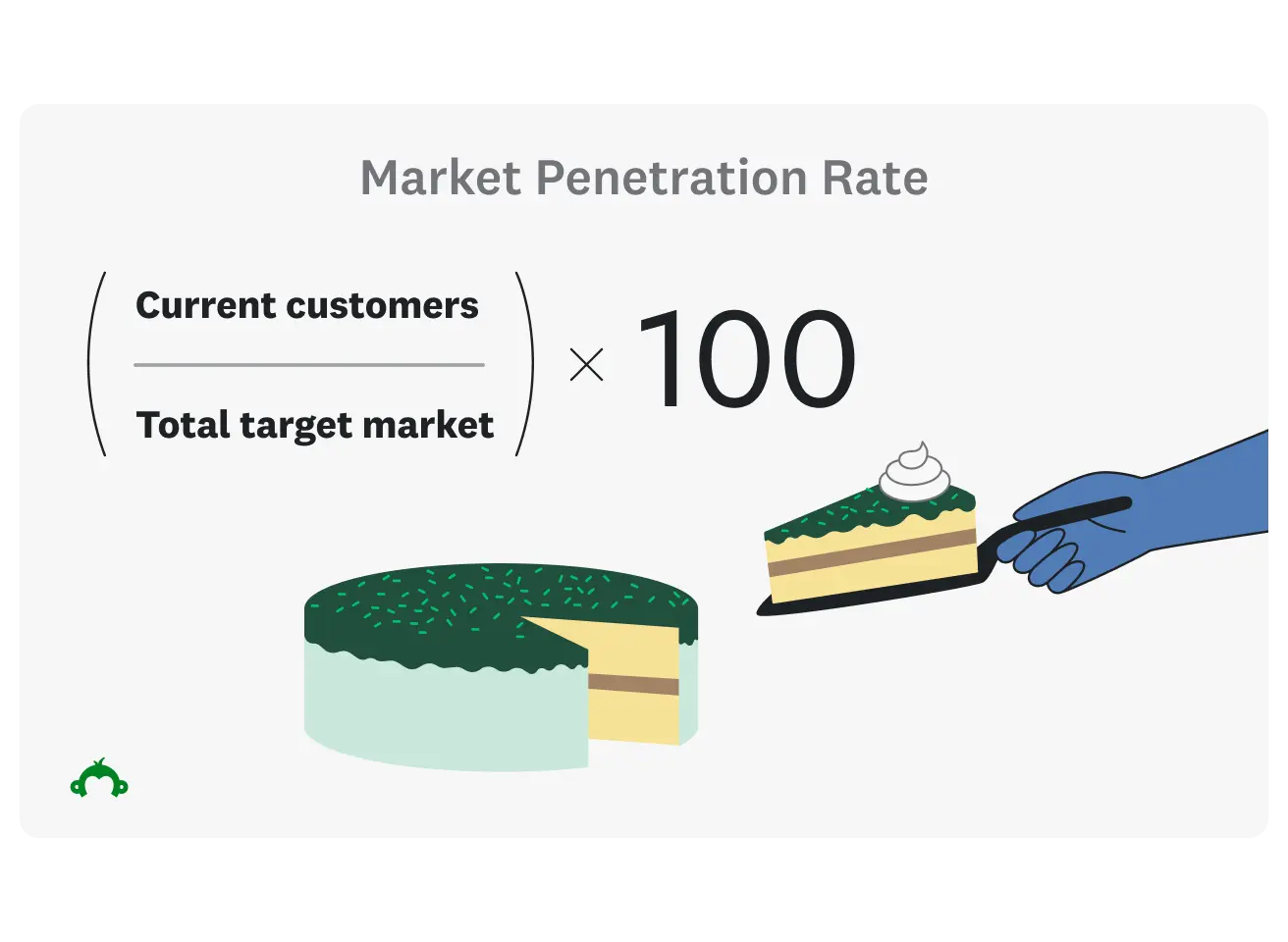
- Divide the number of customers by the total target market
- Multiply the result by 100 to get the market penetration percentage
For example:
Imagine a company has 75,000 customers in a market with 500,000 potential buyers. You can use the market penetration formula to work out its market share.
Market Penetration Rate = (75,000 / 500,000) x 100 = 15%
This means the company has captured 15% of the total target market.
For an accurate assessment of your market penetration, it’s essential to use precise data and factor in current market trends and changes. Common pitfalls include overestimating the size of the total market, missing shifts in customer behaviour or overlooking competitor impact.
Related reading: Market research: Definition, importance and how to get started

The benefits of market penetration
Market penetration is vital for driving business growth and ensuring long-term success. By applying an effective market penetration strategy and growing your market share, you can boost sales volume and strengthen your position as a market leader.
Here are some key benefits of market penetration:
- Increases market share: Gaining a larger share of the market enables your business to expand its presence and become a market leader. The higher your market share, the more you can influence industry trends and attract new customers, securing long-term sustainability and a competitive edge.
- Boosts revenue: As your market penetration rises, so does your customer base, resulting in sales growth. With more customers buying your product or service, your overall revenue increases, enabling further reinvestment in business development and expansion.
- Builds brand awareness: Increasing your market share means more people are exposed to your brand. The more customers who know about your business, the greater their trust and the more likely they are to become repeat buyers. This visibility helps your brand become a go-to choice in the market, attracting new potential audiences.
- Strengthens competitive position: Greater market penetration provides a competitive advantage by cementing your position in a particular market. It improves your bargaining power with suppliers, helps attract top talent and enables you to establish key partnerships, all of which help maintain a robust competitive edge.
- Encourages customer loyalty: When a company reaches a wider audience, it can concentrate on refining its products or services to better meet customer needs. Loyal customers are more likely to stay with your brand, driving demand, ensuring steady revenue and spreading positive word-of-mouth that brings in new customers.
- Achieves economies of scale: As your customer base expands, your production and operational costs per unit typically decrease. This comes from being able to handle higher volumes, optimise processes and secure better deals with suppliers, making your business more cost-effective.
- Provides a stable foundation: A strong, diverse customer base creates a stable foundation for future growth. With significant market penetration, your business can navigate economic downturns or changes in consumer behaviour, knowing that you have built a broad, loyal following.
- Mitigates risk: Market penetration lets you spread risk across different customer segments, products or regions. Not being dependent on a single area reduces the chance of significant losses if one part of your business underperforms.
- Drives innovation: As you expand your reach and engage with a wider customer base, you gain fresh insights and feedback. This enables your business to invest more in innovation, develop new solutions and continually enhance your offerings to meet changing customer needs.
- Enhances market influence: The greater your market penetration, the stronger your influence becomes in a competitive landscape. With a larger market share, your brand equity grows, and you're in a better position to influence trends, shape consumer behaviour and drive the market's direction.
Related: Learn about market segmentation
10 market penetration strategies for business growth
To increase market penetration and accelerate business growth, you can apply a range of strategies that focus on various parts of your operations, from pricing and promotion to customer experience. Here are 10 effective market penetration strategies that can boost market penetration:
1. Adjust pricing strategies
Pricing can make or break a product’s success in the market. Strategically lowering prices or offering tiered pricing to different customer segments can attract new markets. Alternatively, premium pricing can position a product as high-value, appealing to customers seeking exclusivity.
Changing pricing strategies can also be a flexible way to respond quickly to market conditions or competition. By experimenting with discounts, bundling, targeted promotions or loyalty rewards, you can find competitive pricing models that best appeal to your existing customers and potential markets, increasing sales volume and market penetration.
2. Develop new products or services
Expanding your offerings based on customer needs opens new growth strategies. Introducing new products or services that complement your existing ones can attract different customer segments, increase engagement, expand market share and improve market penetration.
Regularly refreshing your portfolio with new, innovative solutions demonstrates to customers that your company is forward-thinking. This drives long-term loyalty and brings in new audiences along the way.
3. Expand into new geographic regions
Entering new geographic markets, locally or internationally, allows brands to reach untapped customer bases. This market penetration strategy can be especially effective if there’s a demand for your product or service in those regions, increasing your overall market share.
Tailoring your offerings to new regions' cultural and economic specifics can help you build a strong brand presence and optimize your market penetration.
4. Form strategic alliances or partnerships
Strategic partnerships can amplify your brand’s visibility and enhance customer trust, making it easier to penetrate new markets. These alliances allow you to leverage the reputation, value proposition and customer base of established partners in mature markets.
Whether it’s through co-marketing campaigns, joint product launches or distribution agreements, partnerships open up opportunities for more customers to discover your brand and what you offer.
5. Revamp and improve existing offerings
Continuously improving your products or services keeps your existing customers satisfied while gaining market share. Whether adding new features, improving quality or upgrading your customer service, regular enhancements can help you stay competitive and grow your market share.
Customer expectations are always evolving, so it’s essential to stay ahead by innovating your existing products. Offering upgrades or improvements based on customer feedback not only satisfies current users but also positions your brand as a leader in innovation, increasing customer loyalty and market penetration.
6. Pursue mergers and acquisitions
Mergers and acquisitions offer an efficient way to boost market penetration rapidly. By acquiring competitors, you can broaden your customer base, access new markets and benefit from new technologies or expertise.
Merging with or acquiring companies in complementary sectors can speed up growth and provide rapid access to established markets. The right acquisition can greatly expand your reach and create synergies that strengthen your business’s long-term competitiveness.
7. Launch limited-time promotions or discounts
Offering limited-time promotions or discounts creates a sense of urgency and motivates customers to buy sooner rather than later. Flash sales, bundle deals and exclusive offers are effective tools for driving rapid short-term market penetration.
These promotions are especially effective at attracting customers who may be hesitant to purchase or are unfamiliar with your brand. When combined with targeted marketing campaigns, limited-time offers generate excitement and drive immediate action, leading to increased market share and customer acquisition.
8. Boost investment in sales teams
A skilled and motivated sales team can dramatically boost customer acquisition and drive market penetration. By investing in training, tools and resources for your sales staff, you enhance their effectiveness and ensure they’re well equipped to win new customers and increase sales.
An empowered sales team has a direct impact on market penetration. With the right incentives, up-to-date product training and access to modern sales tools, your team can identify high-value leads, build strong customer relationships and close deals more effectively, ultimately expanding your market reach.
9. Focus on improving customer experience
Providing exceptional customer service and a seamless buying experience can help improve customer retention and encourage word-of-mouth referrals. When customers have a positive experience, they’re more likely to return and recommend your brand, which can lead to increased market penetration.
Customer experience isn’t just about resolving issues; it’s about creating positive, memorable interactions at every stage. Provide personalised experiences, speedy resolutions and proactive service to set your business apart and turn customers into loyal advocates who grow your market presence.
10. Utilise digital channels and social media for growth
Making the most of digital marketing channels, including social media, search engine optimisation (SEO) and paid advertising, helps businesses reach a wider, more targeted audience. Use these platforms to engage potential customers and boost brand awareness.

How to measure market penetration with surveys
Market research surveys gather direct feedback from the people who matter most: your customers. They give you valuable insights into how many people interact with your brand, how they view your offerings and where improvements might be needed. Surveys are also a highly effective tool for building successful market penetration strategies to grow your market share.
Rather than guessing about customer behaviour or relying on assumptions, surveys enable you to collect quantitative and qualitative data on customer perceptions, satisfaction and buying habits.
If you’re unsure where to focus your marketing efforts, surveys can highlight key opportunities for growth, whether that’s reaching new demographics, expanding into underserved regions or improving customer satisfaction with your current products.
With the SurveyMonkey selection of market research survey templates, companies can ask targeted questions to gain insights into everything from brand awareness to customer loyalty. As your understanding of the market grows, you can refine customer acquisition strategies and work towards increasing your overall market share.
Related: How to develop market intelligence
Measure market penetration with SurveyMonkey
Tracking your market penetration is vital for understanding how effectively your product or service reaches your target audience. SurveyMonkey offers a variety of market research survey templates to help you get started, whether you’re looking at general market trends or exploring consumer behaviour surveys.
Try market research tools like Net Promoter Score® (NPS) surveys to enhance market penetration and grow your brand awareness. With the right data, you can make informed decisions, refine your strategy and confidently increase your market share.
Net Promoter, Net Promoter Score and NPS are trademarks of Satmetrix Systems, Inc., Bain & Company, Inc. and Fred Reichheld.
Ready to get started?
Discover more resources

Solutions for your role
SurveyMonkey can help you do your job better. Discover how to make a bigger impact with winning strategies, products, experiences and more.

Concept testing ultimate guide
Find out how to plan, design, send, and analyze your own concept testing survey. Read our comprehensive guide on concept testing to learn everything you need to know to bootstrap your own concept testing program, with methods for everything from ad and logo testing to product and packaging design. Validate your gut instincts and sort great ideas from good ones.

Ad testing: Why it matters and how to successfully perform it
Learn how to run an ad test, from picking stimuli and metrics to analysing results with Top 2 Box scores, plus best practices and real examples.

See how the Western Australian Police Union uses data to power reform
Discover how the Western Australian Police Union uses SurveyMonkey insights to protect the rights, interests, and welfare of its members.