Open-ended vs. closed-ended questions: Best practices, tips & examples
Learn how open-ended and closed-ended questions work, when to use them and how to combine both formats for clearer, more actionable survey insights.

Open-ended questions collect written, qualitative feedback in respondents’ own words, while closed-ended questions capture structured, quantitative data through predefined answer choices. Understanding how these formats differ and knowing when to use each one helps you design surveys that uncover motivations, reveal patterns and make your results easier to interpret.
This guide explains the difference between open-ended and closed-ended questions with clear definitions, examples and guidance on when each format works best. You’ll learn how combining both approaches leads to stronger insights and more confident decision-making.
Open-ended vs. closed-ended questions: What’s the difference?
Open-ended questions collect qualitative detail in respondents’ own words, while closed-ended questions produce structured, quantifiable data. Each format plays a different role in survey design, and using them together helps you understand both what people think and why they think it.
- Open-ended questions add depth by capturing context, personal experiences and motivations.
- Closed-ended questions provide consistency and make it easier to spot patterns or compare groups.
Knowing when to use each helps you design surveys that balance depth and efficiency, which ultimately leads to clearer insights and stronger decisions.
Comparison of open-ended and closed-ended questions
| Feature | Open-ended questions | Closed-ended questions |
| Structure | Respondents write answers in their own words | Respondents select from predefined options |
| Question format | Text boxes, comment fields, follow-up prompts | Multiple choice, yes/no, rating scales, ranking questions |
| Data type | Qualitative, exploratory insights | Quantitative, structured feedback |
| Advantages | Provides context and nuance, surfaces new ideas | Easy to analyse, consistent across respondents |
| Limitations | Takes more time to answer and evaluate | Cannot capture full nuance or unexpected feedback |
| Best use cases | Understanding motivations, gathering detailed feedback, exploring new topics | Measuring trends, benchmarking, screening respondents, comparing groups |
When to use open-ended vs. closed-ended questions
Open-ended or closed-ended? How about both:
- Use open-ended questions when you need context, ideas or explanations that cannot be captured with fixed choices.
- Use closed-ended questions when you want quick, consistent data that’s easy to quantify or compare.
- Use both formats together to pair reliable metrics with deeper insights into what drives them.
What is an open-ended question?
An open-ended question is a survey question that invites respondents to answer in their own words, providing qualitative detail rather than selecting from predefined options. These questions help you understand context, motivations and lived experiences that numeric data alone can’t capture. They reveal the thinking behind a response, making your results more meaningful and actionable.

Types of open-ended questions
Open-ended questions take many forms, depending on the kind of insight you want to uncover.
- Exploratory questions help you learn what respondents think or feel about a topic without limiting direction.
- Follow-up questions invite people to explain or expand on a previous answer.
- Feedback questions give respondents space to share suggestions, frustrations or ideas in their own words.
- Diagnostic questions help uncover root causes behind trends or issues you see in your structured data.

How open-ended questions work
Respondents answer open-ended questions by typing into a text field, using as much or as little detail as they choose. These responses generate qualitative data that you can review manually or analyse using features such as SurveyMonkey text analysis, rule-based tagging or Sentiment Analysis. These features help you identify themes, emotions and important patterns across large volumes of written feedback.
Pros and cons of open-ended questions
Pros
- Richer detail: Written responses help you understand the experiences and nuances that shape opinions.
- Unexpected insights: Respondents may reveal themes or ideas you wouldn’t have captured with fixed choices.
- Authentic voice: People can share feedback in their own language, which often increases clarity and honesty.
Cons
- More effort for respondents: Longer text questions can slow people down and reduce completion rates if overused.
- Variable quality: Responses can drift off-topic or provide limited value when questions are vague.
- More time to analyse: Qualitative data requires additional review or text analysis to interpret at scale.
Open-ended question examples
Here are several examples across common survey use cases:
- Customer satisfaction: What was the most helpful part of your support experience?
- Employee feedback: What is one change that would improve your day-to-day work?
- Product research: What problem were you trying to solve when you chose this product?
- Event feedback: What could we improve for future events?
- Education: What concept would you like more time to practise or review?
When to use open-ended questions
Open-ended questions work best when you need a deeper understanding rather than a quick measurement. Use them when you want to capture experiences, motivations, expectations or frustrations in respondents’ own words.
They also work well as optional follow-up questions after a closed-ended item, as this gives people a chance to explain their rating without slowing down the rest of the survey.
If you expect many respondents to take your survey on mobile, keep open-text items brief and place them strategically to support your data goals without causing fatigue.
What is a closed-ended question?
A closed-ended question is a survey question that asks respondents to choose from predefined answer options, producing structured and quantifiable data. This format helps you measure trends, compare groups and analyse results quickly, as each response fits into a clear set of categories.
Types of closed-ended questions
Closed-ended questions come in many formats, each supporting different research needs.
- Binary questions (yes or no) prompt simple, fast decisions.
- Multiple-choice questions offer a list of possible answers and are one of the most common formats in surveys.
- Likert scale questions measure agreement, attitudes or frequency.
- Rating scale questions use numbers or words to capture satisfaction or quality.
- Ranking questions ask respondents to order items based on preference or importance.
- Demographic questions categorise respondents by age, location, income and other attributes.
How closed-ended questions work
Closed-ended questions rely on structured response options that make it easy for respondents to choose an answer and easy for you to analyse results. Because every answer maps to a specific category or number, these questions support statistical analysis, benchmarking and trend tracking.
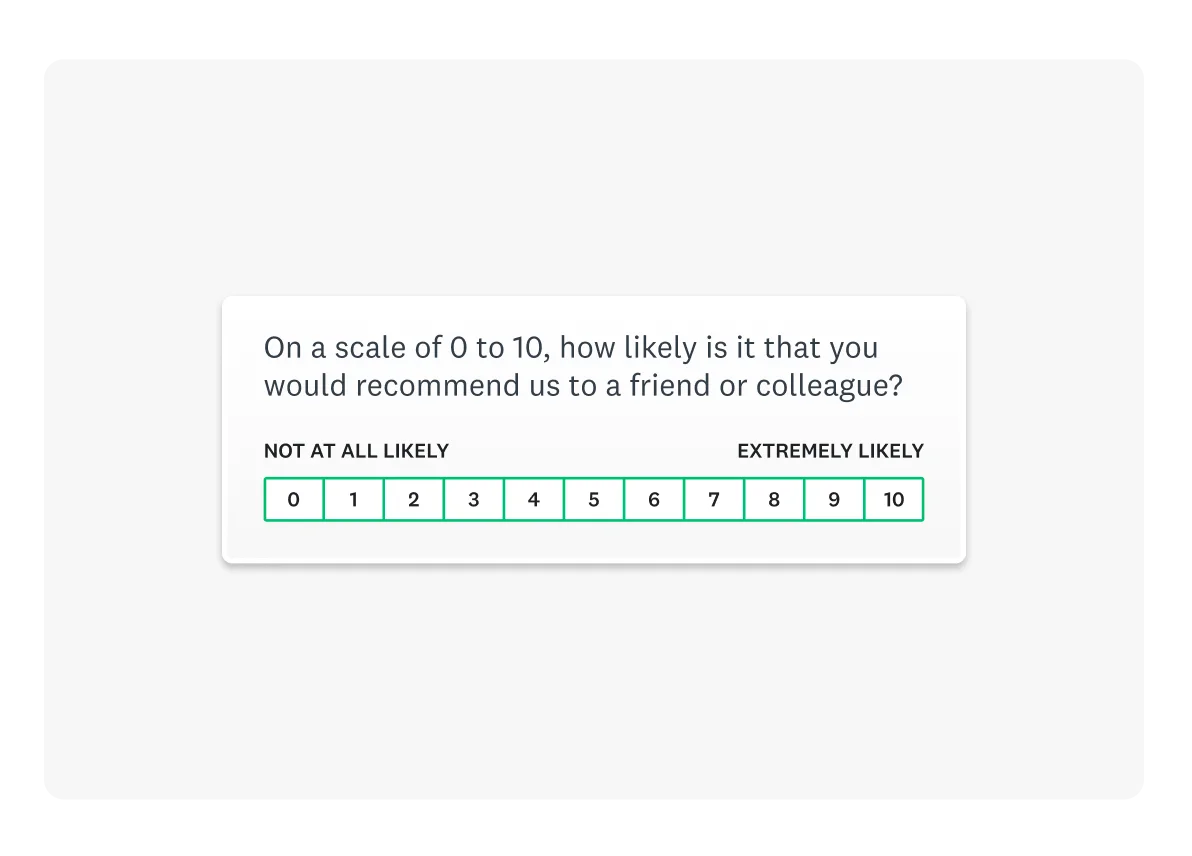
Closed-ended questions are especially useful when conducting quantitative research. For example, a survey using the Net Promoter Score® (NPS®), an industry-standard metric for measuring customer loyalty, uses a single closed-ended rating question (0–10) as the foundation of the entire survey.
Pros and cons of closed-ended questions
Pros
- Quick to answer: Respondents can select an option with minimal effort, which helps them run through surveys smoothly.
- Easy to analyse: Results fall into consistent categories that work well for charts, filters and comparisons.
- Great for screening: Closed-ended questions make effective screening questions at the start of a survey to ensure the right people proceed.
Cons
- Limited nuance: Fixed choices can’t always capture the full range of opinions or experiences.
- Potential for bias: If answer choices are incomplete or unbalanced, they can influence how respondents answer.
- Less flexibility: Respondents who don’t see an answer that fits may select an option that doesn’t reflect their true perspective.

Closed-ended question examples
Below are examples across common survey types:
- Customer research: How satisfied are you with your experience? (1 to 5)
- Employee feedback: Do you feel you have the resources you need to do your job? (Yes or No)
- Product research: Of the following features, which one do you use most often? (Select one)
- Event feedback: How likely are you to attend this event again? (0 to 10)
- Education: How confident do you feel about today’s lesson? (Not at all, somewhat, very)

When to use closed-ended questions
Closed-ended questions are the right choice when you need structured data that’s easy to quantify and compare. They work well when measuring satisfaction, awareness, preferences or behaviour across many respondents. Use them to track changes over time, benchmark results or filter responses into clear groups. They’re also ideal early in a survey when you want to keep respondents moving with simple, predictable choices.
7 tips for writing effective open-ended and closed-ended questions
Strong survey questions help you collect feedback that’s easy to interpret and meaningful to act on. These seven practices provide a simple framework for designing questions that work well across both formats, whether you’re gathering quick metrics or looking for deeper insights.
1. Start with a clear research goal
Before writing any questions, define what you want to learn and how you expect to use the results. A clear goal makes it easier to decide which topics to explore, how detailed your questions should be and where open-ended or closed-ended formats will work best.
2. Choose the right mix of open-ended and closed-ended formats
Use closed-ended questions to consistently measure attitudes, preferences or behaviour. Add open-ended questions when you want to understand the motivations behind a response or explore an idea in more detail. Blending both formats gives you strong quantitative data along with the context needed to interpret it.
3. Write clear and neutral questions that focus on a single idea
Clarity drives better responses. Keep questions simple, specific and free of assumptions or bias. Avoid leading phrasing by checking your wording against resources such as our guide to good survey questions and tips on avoiding loaded questions. Make sure each question addresses only one idea so your data stays clean and easy to analyse.
4. Select answer scales that reflect real attitudes or behaviours
When using closed-ended formats, choose answer scales that provide respondents with enough options to answer accurately. Simple agree/disagree questions may not capture nuance, whilst overly large rating scales can create noise rather than insight. Select the smallest scale that still supports clarity and useful comparisons.

5. Use open-text questions strategically to reduce fatigue and capture context
Open-ended questions are helpful when respondents need space to explain a rating or describe an experience. Use them thoughtfully and limit the number required to keep the survey easy to complete, especially on mobile devices. Optional open-text follow-ups are an effective way to collect context without slowing everyone down.
6. Test your survey on mobile devices to ensure readability
Six out of ten surveys are taken via mobile, according to our research. Your survey should be phone-friendly to ensure high response rates. Review your survey on a mobile screen to confirm that questions are readable, open-text boxes are manageable and answer choices don’t feel crowded.
7. Use SurveyMonkey features, templates and the Question Bank to strengthen your design and analysis
If you need a head start, explore our survey templates or browse thousands of pre-written ideas in the Question Bank. Once responses start coming in, features such as rule-based tagging for sorting open-ended answers and built-in Sentiment Analysis make it easier to interpret both qualitative and quantitative feedback.
Build clearer surveys with better open-ended and closed-ended questions
Designing strong open- and closed-ended questions is easier with the right support. SurveyMonkey gives you intuitive tools to create thoughtful questions, refine your survey flow and analyse both qualitative and quantitative feedback with confidence.
You can start with a customisable survey template or explore thousands of expert-written ideas in the Question Bank. AI-assisted features help you draft and improve questions, whilst text analysis, rule-based tagging and real-time reporting make it simple to interpret written responses alongside structured data.
Whether you’re running a quick pulse check or collecting in-depth insights, SurveyMonkey helps you build surveys that are clear, effective and ready to act on. Get started for free.
NPS, Net Promoter and Net Promoter Score are registered trademarks of Satmetrix Systems, Inc., Bain & Company and Fred Reichheld.
Ready to get started?
NPS, Net Promoter and Net Promoter Score are registered trademarks of Satmetrix Systems, Inc., Bain & Company and Fred Reichheld.