How to come up with a business name
Discover how to come up with a business name using best practices and market research.

You’ve developed your concept, product or service, and business model, and completed all the necessary preparations to launch your business. Now, the only thing left is to choose a business name.
Your business name is the foundation of your brand, vital for attracting customers and standing out from the competition. We’ve gathered some useful advice on how to create a business name, including tips and tricks.
Why your business name matters
Your brand name is key to your success. It’s what people use to search for your business online and to talk about your products or services.
The right name not only identifies your business but can determine your success. Consider the following factors that emphasise the importance of naming a business.
- Better stock performance: A 2018 study found that companies with short, positive names attract more investors in competitive markets, leading to higher per-capita shares and increased company value.
- Competitive differentiation: Your business name should make you stand out from competitors and prevent confusion. If your name is too similar to others in your market, customers may be unsure about which company provides the product or service.
- Brand recall: Brand recall tests how easily customers can remember brand names related to a particular industry or product. A catchy business name is much more memorable.
- Drives referrals: Word-of-mouth marketing is a powerful tool. A captivating business name can spread through friends and family, becoming a household name.
How to name a business
Now that you know how important a great business name is, it’s time to choose one. The right place to start is with comprehensive market research. In fact, research is a big part of your name-choosing experience, as shown in this graphic.

Conduct market research
Conducting thorough market research is essential for gaining insight into the significance of your brand name and its potential impact on the marketplace.
This process involves analysing consumer perceptions, industry trends and competitor branding strategies to determine how your name resonates with your target audience.
By understanding these factors, you can make informed decisions that match market expectations and boost your brand’s presence and impact.
Competitor analysis
Who are your main competitors? What are their names? Keep these in mind when considering your name. If your name is too similar, you risk losing customers to the competition.
Related reading: How to conduct a competitive analysis with the help of surveys
SEO research
Organic and search engine marketing will probably form a major part of your marketing strategy.
- Organic marketing: A strategy that uses natural outreach methods such as blog articles, social media posts, email campaigns and user-generated content to engage and convert potential customers.
- Search Engine Marketing (SEM): A strategy that uses paid adverts to increase a company’s visibility on search engine results pages (SERPs). Often called paid search or pay-per-click (PPC), SEM enables businesses to reach specific audiences by appearing at the top of search results.
Use these marketing methods to identify the best-performing keywords for businesses offering products or services similar to yours. Make sure the keywords are relevant to your business and that the average monthly search volume is high enough to attract attention.
SEO may be a small factor in your actual naming process, but if you can fit a keyword naturally into your business name, go for it. This research process also exposes you and your team to a variety of high-traffic keywords that assist future marketing campaigns.
Qualitative customer research
Ask your potential customers how they view your competitors’ names. What they like or dislike about them gives you some initial direction. For example, they might find a name too tacky, too short or too similar to another brand. This gives you a starting point for your naming.
Market research surveys
Use market research surveys to collect real data directly from your customers. These surveys can help you:
- Expand your competitor list
- Build customer demographic information
- Measure brand awareness (useful if you’re going through a name change)
- Assess customer behaviour
Use this information to develop customer profiles and determine how customer groups are most likely going to interact with your name.
Brainstorm business names
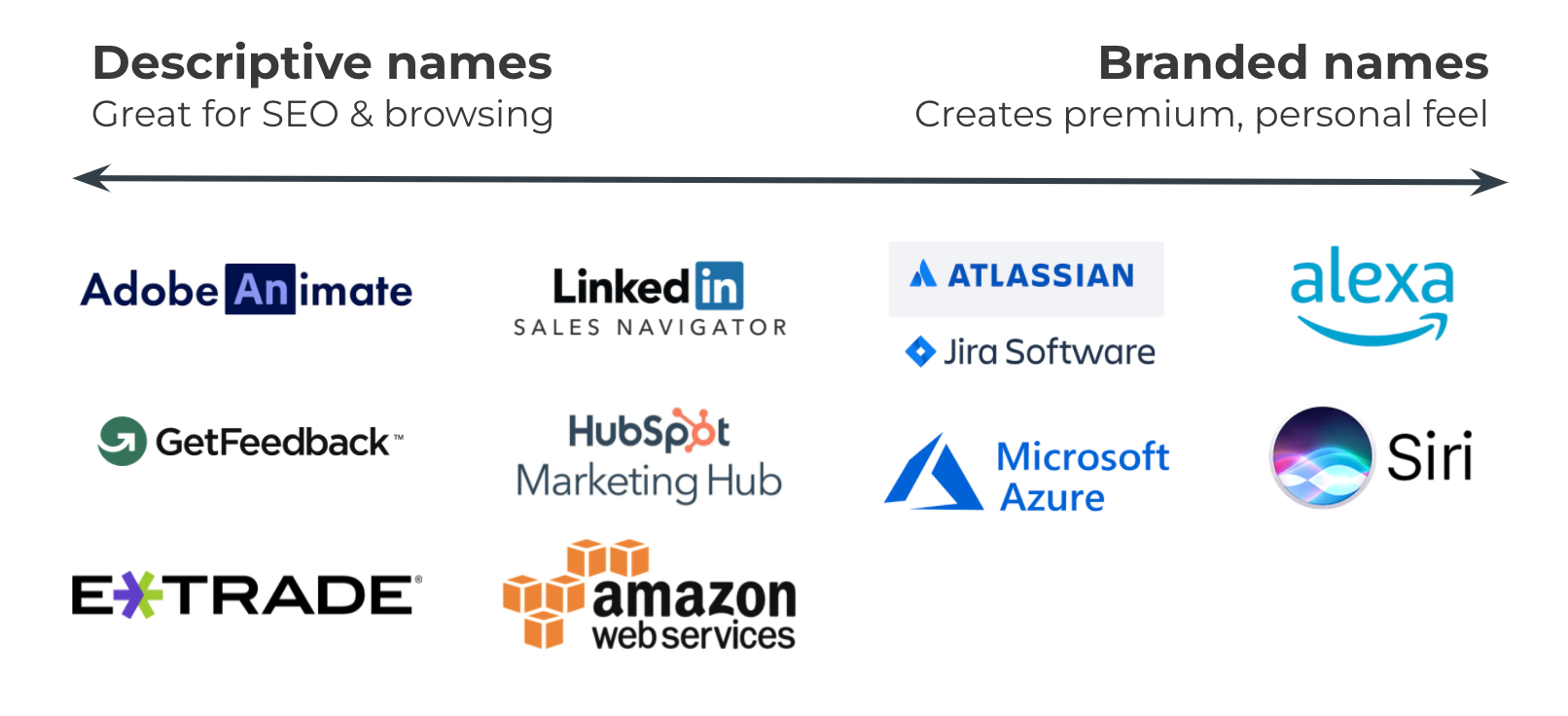
Go on – start brainstorming! Write down every idea, working with your team or other stakeholders to come up with names and record them all. You’ll most likely end up with quite a long list, which is exactly what we’re aiming for.
You want to begin with as many potential business names as you can. And yes, you can use a business name generator to help you get started. (We’ll cover that a bit further down.)
First, define your evaluation criteria and use them to guide your list. Take the following factors into account.
- Brand fit: Does the name align with your company’s vision and values? If not, cross it off the list.
- Competitive differentiation: Is the name different enough to your competitors? Is there a company a customer could confuse your brand with? If so, cross it off the list.
- Resonates with the target buyer: Go through the names with your team, friends, family and target audience. Any name that doesn’t resonate should be removed.
- Allows for future expansion: Don’t include a keyword in your name that will restrict business growth. Today, you may be making women's shoes, but someday, you may expand into handbags, men's shoes or children's shoes.
- Avoid negative connotations: Your name should not evoke any hints of racism, inequality, unfairness or exclusivity of anyone of any culture.
- Customer and employee belonging: You, your customers and your employees should all feel comfortable and included as part of your brand family.
Primarily, market research and competitor analysis will shape your brainstorming session. Use these tips, guidelines and high-quality market research to make your ideation process as effective as possible.
Leverage Sentiment Analysis
Sentiment Analysis uses text analysis, natural language processing and computational linguistics to systematically identify, extract, quantify and analyse information. You can use Sentiment Analysis tools to examine your market research and discover actionable insights.
This means quickly identifying patterns in customer responses. With Sentiment Analysis, you can filter results, identify and remove low-quality responses, and detect trends to inform your choice of entity name.
Use acronyms
You can probably think of several companies that use acronyms as their business names. If your business is complex, a memorable acronym could be a smart choice.
- 3M stands for The Minnesota Mining and Manufacturing Company
- AT&T stands for American Telephone and Telegraph Company
- EPCOT stands for Experimental Prototype Community of Tomorrow
- NASA stands for National Aeronautics and Space Administration
- NERF stands for Non-Expandable Recreational Foam
- WD-40 stands for Water Displacement 40th formula
Create mashups
Combine two or three meaningful words that reflect your brand identity to create a descriptive name. This approach can also help customers quickly recognise what your business offers.
Examples:
- Netflix = internet + flicks (films)
- TripAdvisor = trip + advisor
- Nabisco = National + Biscuit + Company
- Evernote = forever + note
Employ foreign words
You can use foreign words if you wish, but make sure they don’t have an unintended meaning. Do your research and reach out to a native speaker before selecting a final name.
Examples:
- LEGO is actually a mashup of two foreign words, “leg godt”. In Danish, this means “play well”, which is a perfect name for a toy company.
- Chipotle comes from the Nahuatl word for a smoke-dried jalapeño – an ideal name for a Mexican restaurant.
- Über is a German word meaning over, above or across. In this case, the ridesharing platform has dropped the umlaut.
- Acer is the Latin word for sharp, acute, able and facile. That sounds about right for a tech company, wouldn’t you agree?
- Zappos comes from the Spanish word for shoes (zapatos), which is exactly what Zappos sells.
Use a name generator
Use a business name generator, such as Namelix, to come up with punchy, memorable business and product names. This service uses AI to suggest names and logos, letting you input name style, randomness and brand info.
Not all brand name generators use this level of complex processing, and it helps to try out a few name generators. You may discover name ideas you haven’t thought of or be inspired to innovate names already on your list.
Regardless, you still need to double-check the names on your list against your evaluation criteria. Name generators won’t have the same rubric and must-haves you do. Narrow down your existing list to the best of the best.
Perform brand name testing
Now that you have a shortlist of business name options, it’s time to do further research to see which name resonates most with your target customers. SurveyMonkey offers a range of market research solutions for brand name testing.
Idea screening
Idea screening is the process of assessing new products and business concepts in the early stages of development to ensure they align with company goals and customer needs.
This crucial step minimises the inherent risks in name development by narrowing the focus. Early idea screening research identifies name ideas with a higher chance of market success.
You can present your target audience with your narrowed list of business names and ask for feedback on each. Compare them on various metrics, such as appeal, effectiveness and relevance. Use these tips to create an optimised idea screening survey:
- Define your target audience: Use screening questions to identify respondents who match your criteria.
- Use behavioural and industry-specific screeners: Filter respondents based on customer behaviour or rule out those with industry biases. For example, a pet food company should disqualify respondents who don’t own or plan to own animals.
- Be specific in your questions: Avoid general questions that could result in unhelpful answers.
- Avoid yes/no and leading questions: Prompt deeper responses by steering clear of simple or biased answer choices.
- Test and predict incidence rates: If possible, estimate how many people will qualify for your survey using previous data or mini surveys.
- Analyse only complete responses: Make sure your analysis includes only qualified respondents for reliable data.
Use the Idea Screening survey template to harness analytics and AI insights that help you make smarter, market-driven decisions.
Concept testing
Launching a new business name without concept testing can risk a poor consumer response and falling short of your goals.
Concept testing involves gauging how a concept, such as a business name, will be received by consumers before it launches. The most common method is to use surveys to gather feedback. Here’s the basic process for conducting concept testing through surveys:
- Set a goal, for example, finding out whether your target market likes the business name you’ve chosen.
- Use a concept testing survey template or a name testing survey template to design your survey.
- Decide who you’ll send your survey to (making sure you avoid non-representative samples).
- Analyse your results.
- Choose a winning name or refine your existing options and try again.
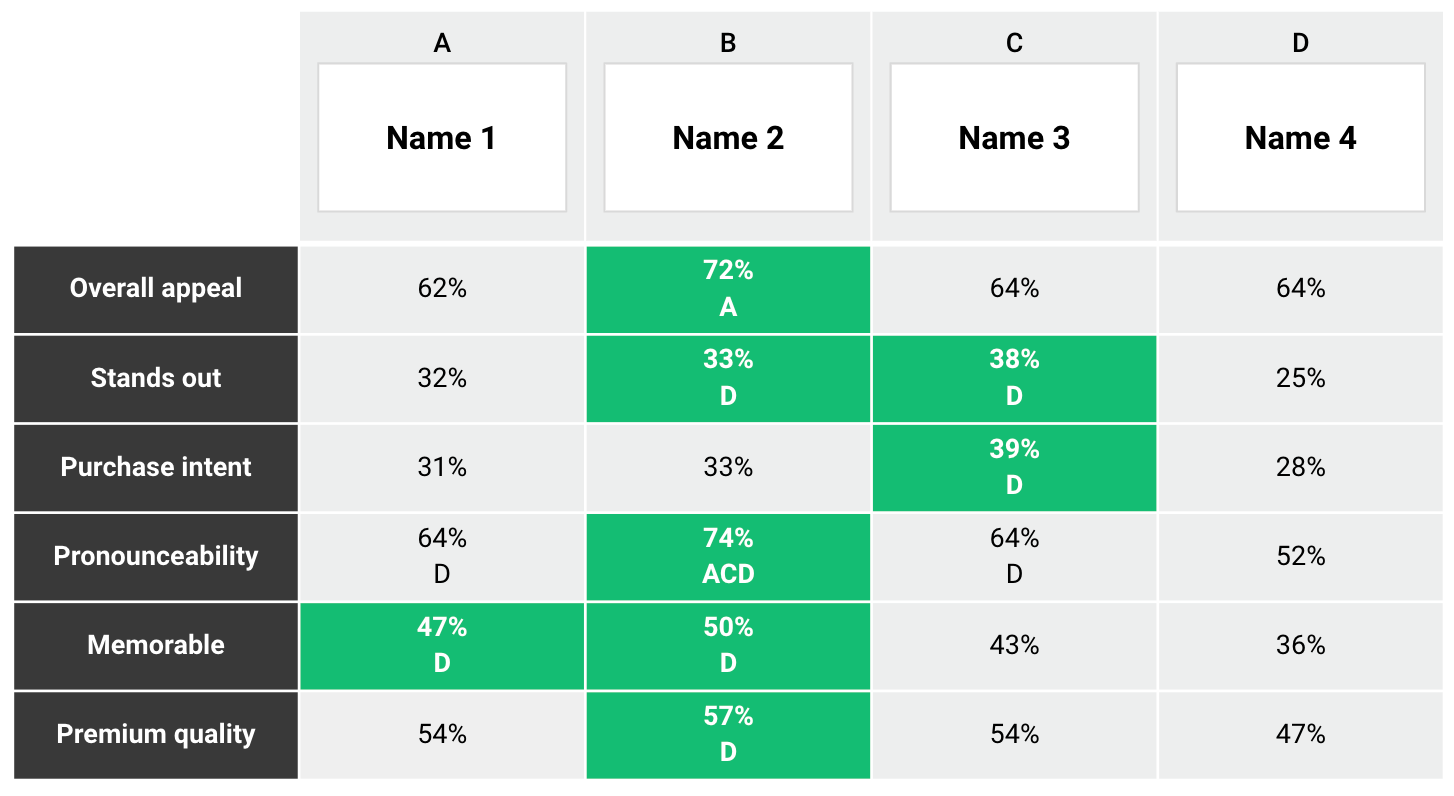
Use audience feedback to make changes or adjustments. For example, let's say the audience preferred Name 2, but you liked Name 4. Respondents said that Name 4 was harder to pronounce. Use that feedback to improve its spelling and pronunciation, then test it again.
Concept testing isn’t always a one-off. You might need to refine your business name options several times before you find one you’re truly happy with. Each iteration brings you a step closer to an effective, apt business name.
Tips for naming a business
Coming up with a business name can be complex, with plenty of factors and methods to consider. Use these final tips to choose a name that resonates with customers, encourages loyalty and stands out from the competition.
Ensure the business name aligns with your audience
It’s tempting to follow in the footsteps of Häagen-Dazs and Etsy, using words that aren’t really words. The names are catchy but convey nothing about the business entity. You'll be better off if you can develop creative business names connected to your vision offerings.
Confirm the business name is evergreen
We can’t overstate how important it is to pick a business name that will grow with you. For example, “Rochester Roofing” might rank well in search results, but what if the company starts offering other home improvement services or expands beyond that area?
Avoid hard-to-spell names
Unique spellings might seem clever, but names like Flickr and Tumblr are often changed by autocorrect. Try running your company name through a spell checker or search engine to check whether it gets autocorrected.
Check business name availability
Be thorough in your research. Just because a name is already in use doesn’t necessarily mean you can’t use it too, but pause and think it through carefully.
In the US, for example, Dove soap and Dove chocolate (Galaxy in the UK), Delta faucets and Delta Airlines, Domino’s Pizza and Domino Sugar have all managed it. But we’d generally advise against doing the same. When it comes to trademarks, the path of least resistance is usually the best.
Pick your final name
It’s time to review your research findings. Examine your data and evaluate your chosen business name using these tips and your own selection criteria.
SurveyMonkey surveys display the results of open-ended questions in a word cloud, helping you spot key insights. Use a Top 2 Box score approach (T2B) to group positive responses to each question into one percentage and simplify your analysis.
Review and choose. Just like that, your business has a name.
Use surveys to name your business
It isn’t easy to choose a business name, but if you follow our advice, it’s a simpler decision powered by customer data. Whatever you do, don’t skip the research steps. They are crucial to ensuring you find the right name. SurveyMonkey has everything you need to perform market research for your business naming process, including concept testing and idea screening. Name your company well and launch a well-marketed business with SurveyMonkey.